

Running into the 2579xao6 code bug with no clear explanation is frustrating, especially when a quick search turns up almost nothing useful. It looks like it should mean something specific, yet there’s no listing for it in Python’s documentation, no package by that name, and no widely reported issue tied to it.
This guide breaks down what the 2579xao6 code bug actually represents, why it likely showed up in your logs or terminal, and how to work through it using the same troubleshooting process professional developers rely on for any unfamiliar error. By the end, you’ll know exactly what steps to take next, regardless of what the identifier itself turns out to mean.
What Is the 2579xao6 Code Bug?

If you’ve landed here after seeing “2579xao6” pop up somewhere in a script, log file, or error message, here’s the short answer: it’s not a recognized standard error in Python or any major programming language.
There’s no official documentation, no entry in Python’s built-in exception list, and no widely known software package tied to that name.
What you’re most likely looking at is an application-specific identifier — a code that a particular piece of software, internal tool, or logging system generated to label a specific failure.
Think of it less like a universal error type (say, ValueError or KeyError) and more like a serial number stamped on a problem so developers can track it internally.
What Are the Common Symptoms of the 2579xao6 Code Bug?
Most people encounter this identifier as part of a larger error message, not as a standalone problem. It usually appears alongside a crash, a failed script, an application freeze, or an unexpected output during data processing.
Common signs include:
- A program stopping mid-execution with a reference code in the output
- A log file entry containing “2579xao6” next to a timestamp
- A support ticket or automated alert citing the code without further explanation
- The same identifier appearing repeatedly for unrelated tasks, suggesting it’s a generic internal label rather than a specific bug type
None of these symptoms point to one single cause. That’s the nature of a project-specific identifier: it tells you something failed, but the real diagnosis comes from the surrounding error message, not the code itself.
Why Is 2579xao6 Suddenly Being Mentioned?
Terms like this tend to spike in search interest for a simple reason: someone encounters it once, searches for it, finds little information, and other people follow the same path. It’s a pattern common to obscure internal error codes that were never meant for public documentation.
There’s no evidence of 2579xao6 being tied to a major software release, a widely used library, or a security vulnerability. It hasn’t appeared in official changelogs, Python’s package index, or established developer forums as a recognized term. The sudden attention is far more likely driven by curiosity and scattered individual reports than by any single confirmed software issue.
Is 2579xao6 Easy to Learn?
This question usually comes from a misunderstanding. 2579xao6 isn’t a programming language, framework, or tool, so there’s nothing to formally “learn” in that sense.
What is worth learning, though, is how to read and respond to unfamiliar error codes in general. That skill applies far beyond this one term:
| Skill | Why It Helps |
|---|---|
| Reading tracebacks | Shows exactly where and why code failed |
| Understanding exceptions | Helps classify the type of problem |
| Checking dependencies | Rules out version conflicts |
| Reviewing logs | Reveals patterns behind repeated errors |
Building these habits matters more than decoding one specific label.
How 2579xao6 Python Code Is Run
Since there’s no actual “2579xao6” package or module, there’s no special way to run it. Any Python script, regardless of what error codes it might produce, runs the same standard way through the interpreter.
A typical execution looks like this:
python myscript.py
If 2579xao6 appears in your terminal output, it was generated by the logic inside that script or one of its dependencies, not by a separate program called “2579xao6.” The Python interpreter itself has no built-in awareness of that string.
How Python Can Be Used for Data Analysis
Python’s popularity in data work comes from its readable syntax and mature ecosystem of libraries. It’s often the first language people reach for when cleaning, analyzing, or visualizing data.
Common tools in this space include:
- pandas for structured data manipulation
- NumPy for numerical computation
- Matplotlib and Seaborn for visualization
- Jupyter Notebooks for interactive analysis
Errors with unusual identifiers, including something like 2579xao6, can surface during data processing when input files are corrupted, missing, or in an unexpected format. Understanding the data pipeline helps narrow down where such an error actually originated.
What Are try and except in Python 2579xao6?
There’s no special version of try and except tied to 2579xao6. These are standard Python keywords used for exception handling, and they behave identically no matter what error label eventually gets triggered.
The basic structure looks like this:
try:
    risky_operation()
except Exception as e:
    print(f"An error occurred: {e}")
If a custom system generates a code like 2579xao6, it likely does so inside an except block, using it as a label attached to the caught exception. The keywords themselves aren’t unique to this error; they’re the mechanism that made catching and labeling it possible in the first place.
How try and except Can Help With a Code Bug
When you’re facing an unfamiliar error like this one, try and except blocks are useful for isolating exactly where things go wrong. Wrapping suspicious code sections lets you catch the exception and print detailed information instead of letting the program crash silently.
A more targeted approach looks like this:
try:
    process_data(file)
except FileNotFoundError:
    print("Missing file detected")
except ValueError as e:
    print(f"Invalid data: {e}")
Catching specific exception types, rather than using one broad except, makes it much easier to trace an unusual identifier back to its real cause. Broad exception handling might hide the very details you need to fix the bug.
Common Causes of an Unfamiliar Code Bug
Most unfamiliar error codes trace back to a small set of recurring problems. Once you rule these out systematically, the mystery usually resolves quickly.
Dependency Problems
Version conflicts between installed packages are one of the most frequent causes of strange errors. A library update that changes its internal behavior can break code that worked fine the day before.
Checking your project’s dependency file and comparing installed versions against what the application expects is usually the fastest way to catch this. Virtual environments help isolate these conflicts so they don’t spread across unrelated projects.
Configuration Problems
Incorrect environment variables, missing configuration files, or mismatched settings between development and production environments often produce cryptic, application-specific error codes. The application itself may generate a custom label simply because it doesn’t know how to describe a misconfigured setting.
Reviewing configuration files line by line, and comparing them against a known working setup, often reveals the issue faster than searching for the error code itself.
Input or Data Problems
Invalid input, corrupted files, or missing data fields can trigger custom error handling that wraps a standard exception in a project-specific identifier. This is especially common in applications that process user-uploaded files or external data feeds.
Testing with a small, known-good sample of data is often the quickest way to confirm whether the input itself is the root cause.
How to Troubleshoot a 2579xao6 Code Bug
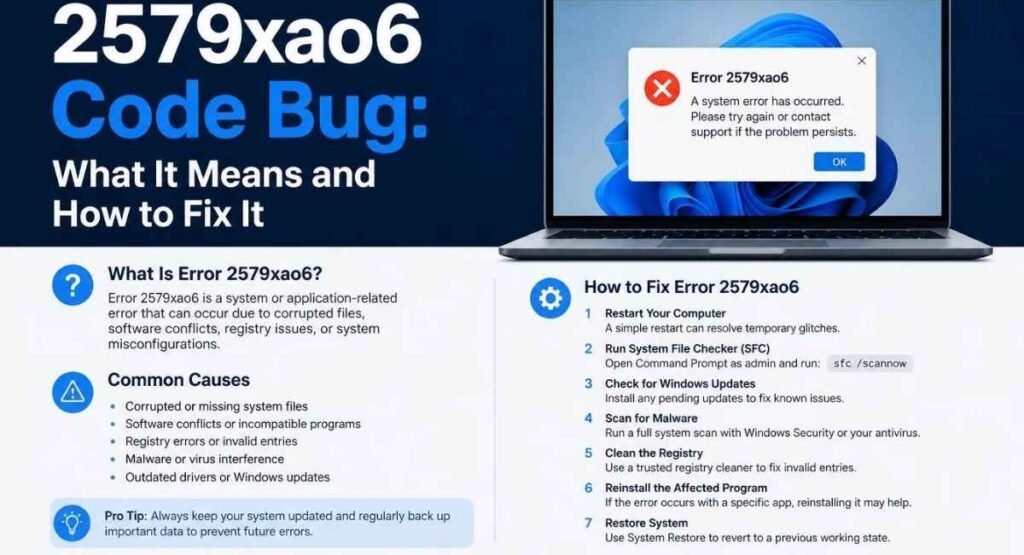
Troubleshooting an unfamiliar identifier is less about the code itself and more about following a consistent process. The steps below work regardless of what specific label your error carries.
1. Capture the Full Error
Never work from a partial screenshot or a single line copied out of context. The complete error message, including any surrounding text, usually contains far more useful detail than the identifier alone.
Save the entire output to a text file before you start investigating. This gives you something to search against and compare later if the issue changes after each fix attempt.
2. Identify the Application
Figure out exactly which program, script, or service produced the error. This sounds obvious, but in larger systems with multiple services running together, it’s easy to misattribute an error to the wrong component.
Check the application logs, the process that was running, and any recent terminal commands. Knowing the source narrows your search dramatically compared to searching the code alone.
3. Reproduce the Problem
A bug you can reliably trigger is far easier to fix than one that appears randomly. Try to recreate the exact conditions that led to the error, using the same inputs, settings, and environment if possible.
If the error only shows up occasionally, note any patterns, such as specific files, times, or user actions that seem to trigger it. Reproducibility is often the single biggest factor in solving a code bug efficiently.
4. Check Recent Changes
Most bugs appear right after something changes. Look at recent code changes, dependency updates, or configuration edits made before the error first appeared.
Version control tools make this easy:
- Review recent commits for the affected file or module
- Check changelogs for any dependencies you use
- Confirm your dependency versions still match a known working configuration
5. Inspect the Traceback
The traceback is the map that leads back to the actual line of code responsible for the failure. Read it from the bottom up, since the final lines usually point to the exact function and file name involved.
Look for a standard Python exception type buried underneath the custom identifier, such as KeyError, TypeError, or FileNotFoundError. That standard exception often explains the real problem far better than the application-specific code wrapped around it.
6. Test the Simplest Possible Case
Strip away everything non-essential and test the smallest piece of code that could produce the error. This isolates whether the problem lies in your logic, your data, or an external dependency.
If the minimal version runs without issue, gradually add complexity back in until the error reappears. That point of failure usually reveals the root cause directly.
How to Prevent the 2579xao6 Code Bug in the Future
Prevention comes down to disciplined habits rather than any single fix. Most unfamiliar error codes are avoidable with a bit of routine maintenance.
Practical steps that reduce recurrence include:
- Pinning dependency versions in your project files to avoid unexpected updates
- Using virtual environments to isolate project dependencies
- Validating input data before processing it
- Logging errors with enough context to diagnose them quickly
- Testing after every software update, not just after major ones
None of these steps are complicated on their own. Applied consistently, though, they eliminate the majority of mysterious, hard-to-trace bugs before they ever reach production.
Is the 2579xao6 Code Bug Dangerous?
Based on everything publicly available, there’s no indication that 2579xao6 is tied to malware, a security vulnerability, or any confirmed dangerous software behavior. It behaves like an internal error code, not a known threat.
That said, any unfamiliar error deserves a cautious look, especially if it appears alongside unusual system behavior, unexpected network activity, or files you don’t recognize. In those cases, the danger would come from whatever triggered the error, not the code label itself.
2579xao6 vs Standard Python Errors
Standard Python exceptions are built into the language and documented in detail. An identifier like 2579xao6 is neither.
| Feature | Standard Python Errors | 2579xao6-Style Codes |
|---|---|---|
| Defined in Python docs | Yes | No |
| Meaning is universal | Yes | No, depends on the application |
| Example | ValueError, KeyError | Custom internal label |
| Where it’s found | Any Python program | Specific application or project only |
| Helps with debugging alone | Often, immediately | Rarely, without more context |
Understanding this distinction saves time. Searching for a standard exception name will usually turn up a clear explanation. Searching for a custom identifier rarely will, since it was never meant for a general audience.
What About the “2579xao6 New Software Name” Claim?
There’s no credible evidence that 2579xao6 is the name of a new programming language, framework, or software product. No official announcement, package registry listing, or established developer community has adopted that name for a real tool.
It’s far more consistent with a randomly generated string, the kind commonly used for internal ticket numbers, session identifiers, or auto-generated error labels. Claims suggesting otherwise appear to be speculation rather than anything sourced from an actual release or project.
Frequently Asked Questions
Is 2579xao6 a real Python error?
No. It doesn’t appear in Python’s standard exception list or official documentation. It’s more likely a custom identifier generated by a specific application.
What should I do if I see 2579xao6 in my terminal?
Capture the full error message and look for a standard exception type nearby, such as ValueError or KeyError. That usually explains the actual problem better than the code itself.
Can 2579xao6 damage my computer?
There’s no evidence linking it to malware or system damage. It behaves like a standard internal error reference rather than a security threat.
Why can’t I find official documentation on 2579xao6?
Because it’s likely a project-specific or auto-generated identifier, not a term used across the broader software industry. Documentation exists for widely adopted tools and standard errors, not internal labels unique to one application.
Is 2579xao6 a virus or malware name?
There’s no confirmed connection between this identifier and any known malware. Unusual activity paired with the error would point to a separate cause, not the code label itself.
Conclusion: What You Should Know About 2579xao6
2579xao6 isn’t a recognized Python error, a programming language, or a piece of known software. It behaves like an application-specific identifier, most likely generated internally to label a particular failure within one project or system.
If you run into it, the identifier itself matters far less than the full error message, traceback, and context surrounding it. Standard debugging steps, capturing the error, checking dependencies, reviewing recent changes, and testing a minimal reproduction, will get you to the real cause far faster than trying to decode the label alone.

Daniel Carter is a digital content writer and researcher at PrimeTechUpdate, specializing in technology, AI, software, business, travel, and digital trends. He focuses on creating accurate, practical, and easy-to-understand content that helps readers make informed decisions. His work emphasizes clarity, reliability, and a reader-first approach.