
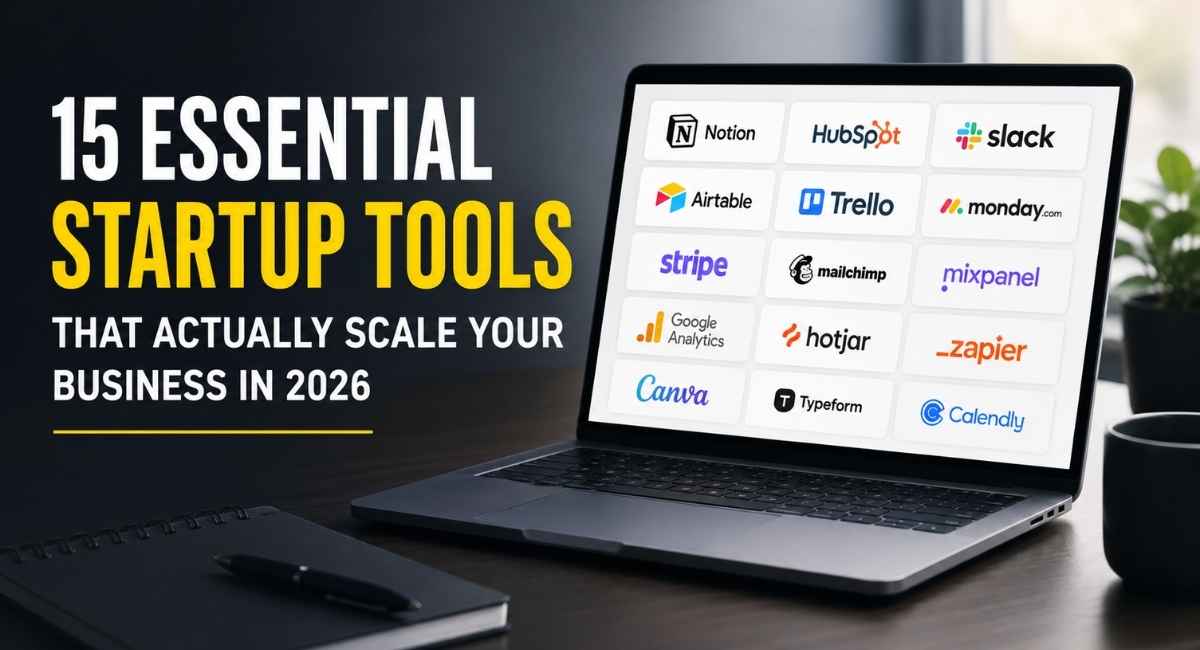
Most growth navigate startup tools promise to fix everything at once. Very few actually do. Startup founders don’t fail because they lack ambition. They fail because their startup tool stack grows faster than their team’s ability to use it well. This guide cuts through the noise and shows you exactly which startup growth tools matter, in what order to adopt them, and how to build a connected software ecosystem that supports real, measurable business growth instead of adding another login screen to your day.
Quick Answer
The right startup software stack covers five core jobs: customer relationships, communication, project delivery, financial visibility, and growth measurement. Early-stage founders need a CRM, a communication tool like Slack, a project hub like Notion or ClickUp, accounting software, and an analytics platform like Google Analytics 4. Add automation tools such as Zapier or Make once manual work starts eating your week. Everything else is optional until your revenue growth and team size demand it.
What Growth Navigate Startup Tools Actually Are (And Why the Definition Matters)
Growth navigate startup tools are software platforms built to help startup founders find direction, not just automate tasks. They combine customer data, real-time data, and business insights so a small team can make data-driven decisions without hiring a full analytics department.
This distinction matters because most articles treat “startup tools” as one giant category. It isn’t. A CRM software for startups and a project management platform solve completely different problems. Lumping them together is why so many founders end up with tool overload and data silos instead of a working system.
A genuine growth navigation tool should answer three questions clearly:
- Where is growth actually coming from?
- Where is the team wasting time or money?
- What decision should happen next?
If a tool can’t answer at least one of those, it’s not a growth tool. It’s overhead dressed up as software.
The Five Pillars Every Startup Stack Needs

A resilient startup technology stack rests on five pillars. Skip one, and the whole system develops blind spots.
1. Customer Relationship and Sales
CRM software for startups like HubSpot, Salesforce, or Zoho keeps every lead, deal, and conversation in one place. Without this, sales pipeline management lives in someone’s inbox, and it dies the day that person is on vacation.
2. Team Communication and Collaboration
Team communication software such as Slack and remote team collaboration tools like Notion or Miro keep distributed teams aligned. Team alignment tools matter more than most founders expect once headcount passes five people.
3. Project and Workflow Management
Project management platforms including Asana, ClickUp, and Airtable turn scattered priorities into a visible, shared startup roadmap. Good workflow automation platforms reduce the number of status meetings a team needs to survive the week.
4. Financial Planning and Visibility
Financial planning tools, accounting software for startups, and cash flow management tools give founders startup financial visibility that investors expect and operators need. This is where burn rate management and startup runway tracking actually happen.
5. Analytics and Performance Tracking
Analytics tools for startups such as GA4, Mixpanel, and Amplitude turn raw traffic into product-market fit signals. Without this pillar, every marketing strategy decision is a guess dressed up as a plan.
| Pillar | Core Job | Example Platforms |
|---|---|---|
| Customer Relationships | Manage leads and deals | HubSpot, Salesforce, Zoho |
| Communication | Keep teams aligned | Slack, Notion, Miro |
| Project Management | Track work and deadlines | Asana, ClickUp, Airtable |
| Financial Visibility | Track cash and spend | QuickBooks, Puzzle, Wave |
| Analytics | Measure growth signals | GA4, Mixpanel, Amplitude |
The Hidden Cost of Tool Chaos (What Competitors Rarely Talk About)
Most guides list tools. Few explain what happens when you pick the wrong combination. This is the part that costs founders the most money and time.
Tool overload isn’t just an annoyance. It’s a measurable drag on operational efficiency. Every disconnected app creates a small tax:
- Data silos that force manual copy-paste between systems
- Duplicate software subscriptions doing the same job
- Slower decision making because no single dashboard tells the whole story
- Lower software adoption because the team gives up switching tabs
A 2026 reality check: subscription creep is now one of the fastest-growing business expenses for early-stage companies. A founder juggling twelve unconnected apps is often paying for six too many, and losing hours weekly reconciling numbers that should already match.
The fix isn’t more software. It’s software integration. Before adding a new tool, ask whether an existing one already does 80% of the job through a native integration or a no-code automation tool like Zapier or Make.
Common Mistakes Startups Make When Building Their Tool Stack
Even well-funded teams repeat the same errors when assembling their startup infrastructure tools.
- Buying for the team you’ll have next year. Enterprise-tier features sit unused for months and inflate cost before revenue justifies them.
- Choosing tools that don’t integrate. A CRM with no email or analytics connection just becomes another manual data-entry job.
- Skipping onboarding. A powerful tool with an untrained team behaves like a weak one.
- Committing to annual billing before validating fit. A free trial or monthly plan protects your startup budget while you confirm real usage.
- Chasing every new AI marketing tool. Novelty doesn’t equal value. Adoption and retention inside your team are the only proof that matters.
How to Build Your Startup Growth Stack in the Right Order
Sequence matters more than selection. Buying analytics software before you have a working sales process just produces empty dashboards.
- Start with communication and project management. Get the team aligned before adding complexity.
- Add a CRM once you have repeatable sales conversations. Don’t install one for a single deal.
- Layer in financial tracking early, even if it’s simple. Founders need cash flow visibility from day one, not after the first funding round.
- Introduce analytics once you have consistent traffic or users. Early-stage teams don’t need enterprise business intelligence tools; they need clear, simple growth metrics dashboards.
- Automate only after a process is proven. Automating a broken workflow just breaks things faster.
- Review the stack quarterly. Cut anything with low usage, duplicate function, or broken integrations.
This order protects two things every founder cares about: startup budget and team focus. It also builds scalable startup systems instead of a pile of disconnected subscriptions.
Matching Tools to Your Startup Stage
Not every tool belongs at every stage. Here’s a practical breakdown of startup tools by stage, matched to what actually moves the needle.
| Startup Stage | Priority Tools | Why |
|---|---|---|
| Pre-seed / Idea stage | Notion, Slack, free CRM tier | Validate the idea without heavy spend |
| Early-stage (post-launch) | HubSpot or Zoho CRM, GA4, basic accounting software | Establish repeatable sales and traffic tracking |
| Growth stage (scaling revenue) | Salesforce or upgraded CRM, Mixpanel/Amplitude, Zapier or Make | Automate handoffs and study user behavior analytics |
| Series A and beyond | Full business intelligence tools, dedicated finance software, investor reporting tools | Support investor confidence with clean, auditable data |
Early-stage startup tools should always favor free or low-cost plans. Most SaaS tools for startups offer generous free tiers precisely because they want you to grow into the paid version later. That’s a fair trade for a lean startup stack.
Free vs Paid: When to Upgrade Your Startup Tools
Free plans work well until they don’t. The signal to upgrade is usage, not ambition.
- Upgrade your CRM when your team exceeds the free contact or seat limit, or when you need automation beyond basic pipelines.
- Upgrade analytics when you need custom event tracking or cohort-based retention analytics, not just pageviews.
- Upgrade project management when cross-team dependencies outgrow a simple board.
- Upgrade accounting software the moment you take outside investment. Investors expect clean, exportable financial records.
Affordable startup software exists at every stage. The goal isn’t the cheapest tool. It’s the tool that removes friction without adding a bill you can’t justify in your next board update.
Frequently Asked Questions
What are growth navigate startup tools?
They’re software platforms that help founders track customer data, team performance, and financial health so decisions are based on evidence, not guesswork.
Which tools should a founder buy first?
Start with communication and project management software, then add a CRM once sales conversations become repeatable.
Are free startup tools good enough for early-stage companies?
Yes. Most cloud-based startup solutions offer strong free tiers that comfortably support a team through its first year.
How many tools should a small startup actually use?
Most healthy stacks run on five to eight core tools. More than that usually signals duplication, not capability.
What’s the biggest mistake founders make with their tool stack?
Buying enterprise-level software before the team or process is ready to use it fully.
How often should a startup review its software stack?
Quarterly reviews catch unused subscriptions, broken integrations, and tools that no longer match the company’s current stage.
Do startup tools really improve revenue growth?
Indirectly, yes. Better customer acquisition tools and sales growth platforms shorten the path from lead to paying customer, which shows up directly in monthly recurring revenue.
Conclusion
The strongest startup growth infrastructure isn’t the one with the most tools. It’s the one where every platform earns its place. Focus on the five pillars first: relationships, communication, projects, finances, and analytics. Add automation only once a process is proven, and review the stack every quarter to keep it lean.
Growth navigate startup tools work best when they’re chosen in order, integrated tightly, and matched honestly to your current stage, not the one you hope to reach next year. Build that discipline early, and your tech stack becomes what it should always be: an operational backbone, not another source of chaos.

Daniel Carter is a digital content writer and researcher at PrimeTechUpdate, specializing in technology, AI, software, business, travel, and digital trends. He focuses on creating accurate, practical, and easy-to-understand content that helps readers make informed decisions. His work emphasizes clarity, reliability, and a reader-first approach.