
If you’re planning a trip to the British Virgin Islands, one of the first practical questions to sort out is money. The currency used in Beevitius, more accurately known as the British Virgin Islands, is the United States Dollar (USD), which means American travelers can arrive without exchanging a single bill. For everyone else, understanding how BVI payment methods work will save you time, stress, and unnecessary fees once you land on Tortola or Virgin Gorda.
This guide covers everything from BVI cash and cards to currency exchange, ATMs, tipping, and even cryptocurrency, so you can plan your trip with confidence.
Quick Answer
The official currency of the British Virgin Islands is the US Dollar (USD). There is no separate BVI official currency, and no British Pound is used day to day. If you’re arriving with US dollars, you’re already set. If not, you’ll need to convert your money into USD before or shortly after arrival.
| Question | Quick Answer |
|---|---|
| What is the BVI currency? | United States Dollar (USD) |
| Since when? | 1959 |
| Do I need to exchange money? | Only if you’re not already carrying USD |
| Are cards accepted? | Yes, Visa and Mastercard widely; Amex less so |
| Are ATMs available? | Yes, mainly on Tortola and Virgin Gorda |
| Is crypto accepted? | Limited, but growing through BVI fintech |
What Currency Is Used in the British Virgin Islands (Beevitius)?
The British Virgin Islands uses US dollars as its sole legal tender. There is no local coinage, no separate banknote design, and no dual-currency system to worry about. When you see a price tag in Road Town or on a menu in Virgin Gorda, it’s already in USD in BVI, the same dollars you’d use in Miami or New York.
This matters because it removes an entire layer of confusion that travelers face in many other Caribbean destinations. You won’t need a currency conversion app just to buy a coffee, and you won’t be handed change in a currency you don’t recognize.
Key facts about BVI currency:
- The US Dollar became the official currency of the British Virgin Islands in 1959.
- Notes come in denominations of $100, $50, $20, $10, $5, $2, and $1.
- Coins are minted in $1, 50, 25, 10, 5, and 1 cent values.
- Despite being a British Overseas Territory, the British Pound has no formal role in everyday transactions.
- British Virgin Islands money is identical in appearance and value to standard US currency, since it is US currency.
For travelers, this means one less thing to plan around. Your biggest decision isn’t which currency to bring, but how much cash versus card to carry.
How to Pay for Things When You Arrive
Once you land, you’ll use a mix of BVI cash and cards depending on where you are and what you’re buying. Larger resorts, marinas, and restaurants in Road Town lean heavily on cards, while smaller vendors, beach bars, and remote islands often expect cash.
Here’s how BVI credit card acceptance typically breaks down:
| Payment Method | Where It Works Best | Notes |
|---|---|---|
| Visa | Hotels, restaurants, larger shops | Widely accepted across all main islands |
| Mastercard | Hotels, restaurants, larger shops | Similar acceptance to Visa |
| American Express | Some resorts and marinas | Not widely accepted at smaller businesses |
| Debit cards | ATMs, larger retailers | Check for foreign transaction fees first |
| Cash (USD) | Taxis, ferries, beach bars, Anegada, Jost Van Dyke | Often the only accepted option in remote spots |
| Mobile payment apps | Select modern retailers | Availability is limited outside main tourist areas |
A few practical points worth knowing before you go:
- BVI ATMs are concentrated in Road Town and Spanish Town, so withdraw cash before heading to smaller cays.
- Notify your bank before travel to avoid your card being flagged or frozen for unusual activity.
- Carry smaller US dollar bills for taxis, tips, and informal vendors who may not have change for a $50 or $100 note.
- If you’re sailing between islands, plan your cash needs in advance since ATMs won’t be available at every anchorage.
Road Town ATMs and Spanish Town’s banking options are your most reliable sources of cash once you’re on the ground, so it’s smart to withdraw what you need for a few days at a time rather than relying on finding a machine in every location.
Why the BVI Uses USD Instead of a British Currency
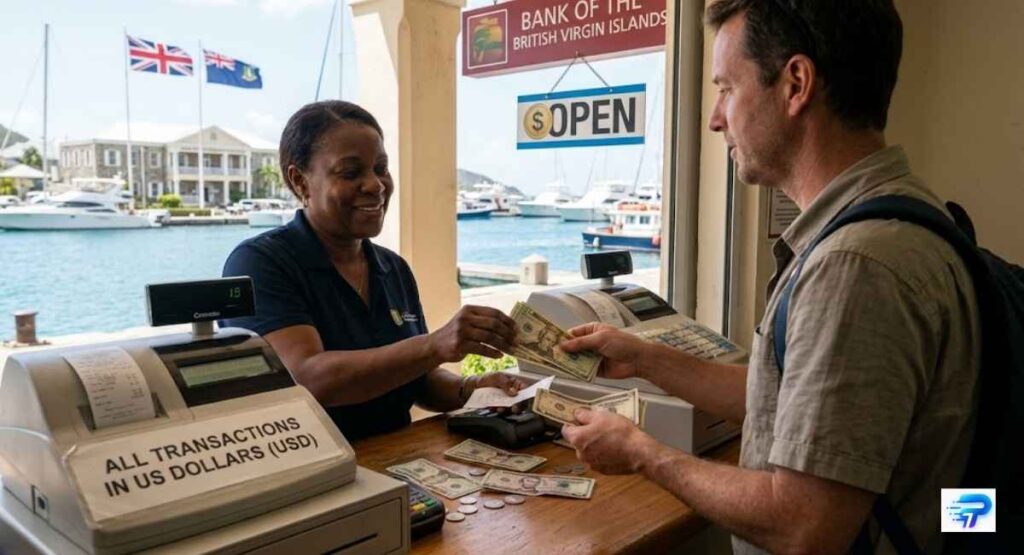
It surprises many first-time visitors that a British Overseas Territory doesn’t use the British Pound. The explanation comes down to geography and economics rather than politics.
The BVI adopted the US Dollar in 1959, decades before its current constitutional relationship with the United Kingdom took its modern shape. At the time, the territory’s economy was closely tied to the neighboring US Virgin Islands, and trade, tourism, and daily commerce all flowed in dollars. Switching to USD made practical sense and has remained the standard ever since.
This arrangement is often called BVI dollarization, meaning the territory has adopted a foreign currency as its own legal tender rather than issuing its own notes and coins. A few reasons this has endured:
- Proximity to the US Virgin Islands and the US mainland keeps trade dollar-based.
- Tourism from the United States makes up a large share of annual visitors.
- USD stability reduces currency risk for BVI banking and the territory’s significant financial services sector.
- Switching to GBP or a new local currency would add cost and complexity without a clear benefit.
Understanding this bit of BVI currency history helps explain why you won’t find Pounds in local circulation, even though the Union Jack still flies over government buildings.
Budgeting: Average Travel Costs in the BVI
Since prices are already in USD, budgeting for BVI travel expenses is straightforward, but costs can run higher than other Caribbean destinations, especially around sailing and yacht charters.
| Expense | Typical Daily Cost (USD) |
|---|---|
| Budget meals (local spots) | $15 to $25 per person |
| Mid-range restaurant meal | $30 to $60 per person |
| Standard hotel room | $150 to $350 per night |
| Boutique or luxury resort | $400 and up per night |
| Taxi (short island hop) | $10 to $25 |
| Rental car per day | $60 to $90 |
| Day sail or charter | $100 to $250+ per person |
Building in a buffer of 10 to 15 percent above your estimated budget is a sensible habit, since ferry transfers, marina fees, and island-hopping add up quickly.
Tipping Etiquette in the British Virgin Islands
Tipping in the BVI follows US-style norms, which makes sense given the shared currency. A service charge of around 10 percent is often already added to hotel and restaurant bills, so it’s worth checking your receipt before tipping again on top.
General guidance:
- Restaurants: 15 percent if no service charge is included.
- Taxi drivers: rounding up or adding a few dollars is standard.
- Hotel staff: $2 to $5 per bag for porters, similar for daily housekeeping.
- Boat crews and charter staff: 10 to 15 percent of the charter cost is customary for a full week.
Practical Money Tips That Most Travel Articles Skip
Beyond the basics, a few lesser-known details can genuinely change how smoothly your trip goes.
- Check your card’s foreign transaction fee before you leave home. Even though you’re spending in USD, some banks still apply a foreign transaction fee simply because the purchase occurs outside your home country. This can add 1 to 3 percent to every swipe.
- BVI currency exchange is rarely needed, but it exists. If you arrive with Euros, British Pounds, or Canadian Dollars, BVI banks in Road Town can convert them, though rates are often less favorable than exchanging before departure.
- Cash is still important on smaller islands. Anegada, Jost Van Dyke, and many private cays have limited card infrastructure, so don’t assume you can tap your way through the whole trip.
- Keep a small emergency cash reserve separate from your wallet. If you lose a card or it gets declined, having backup cash prevents a stressful scramble.
- Money management during a sailing trip needs extra planning. Charter guests should withdraw enough cash for provisioning, mooring fees, and beach bar stops before setting off, since ATMs won’t follow you out to sea.
- Confirm exchange rates before using a currency conversion counter, since airport and marina kiosks sometimes charge a premium over the standard market rate.
Is Cryptocurrency Accepted in the British Virgin Islands?
Cryptocurrency is not a mainstream payment method for everyday purchases in the BVI, but the territory has quietly become an important hub for the industry itself. The BVI fintech and business services sector supports company incorporation for crypto and blockchain businesses, and this reputation sometimes creates the impression that Bitcoin and Ethereum payments are common on the ground. In practice, that’s not yet the case for tourists.
What you should actually expect:
- Most shops, restaurants, and hotels still require USD, whether in cash or card form.
- A small number of tech-forward businesses or private charter operators may accept crypto by special arrangement.
- BVI digital currency initiatives are more focused on the corporate and financial services sector than consumer retail.
- There is no indication that the BVI plans to replace or supplement the US Dollar with an official digital currency for general use.
If you’re hoping to pay for meals or excursions in crypto, bring USD as your primary method and treat any crypto acceptance as a rare bonus rather than a plan you can rely on.
Conclusion
Money matters in the British Virgin Islands are refreshingly simple once you know the basics. The US Dollar is the official currency, has been since 1959, and is accepted everywhere from Road Town hotels to Virgin Gorda beach bars. Cards work well in tourist hubs, but cash remains essential on smaller islands and during sailing trips. Watch your bank’s foreign transaction fees, withdraw cash where ATMs are reliable, and don’t expect cryptocurrency to replace USD any time soon. With this groundwork in place, your BVI trip can focus on the islands themselves rather than money logistics.
FAQs
What is the official currency of the British Virgin Islands?
The official currency is the United States Dollar (USD), used exclusively across all islands since 1959.
Do I need to exchange money before visiting the BVI?
Only if you’re not already carrying USD. Travelers with US dollars can skip currency exchange entirely.
Are credit and debit cards widely accepted in the BVI?
Yes, Visa and Mastercard are accepted at most hotels, restaurants, and larger shops, though American Express is less common.
Where can I find ATMs in the British Virgin Islands?
ATMs are concentrated in Road Town on Tortola and Spanish Town on Virgin Gorda, with fewer options on smaller islands.
Does the British Virgin Islands use the British Pound?
No. Despite being a British Overseas Territory, the BVI uses the US Dollar rather than the British Pound.
Is cryptocurrency accepted in the BVI?
Acceptance is limited to a small number of businesses. USD remains the standard for nearly all purchases.
How much cash should I carry in the BVI?
Enough for taxis, ferries, tips, and purchases on smaller islands where card acceptance is inconsistent, typically a few hundred dollars for a week-long trip.
Will my bank charge foreign transaction fees in the BVI?
Possibly, even though you’re spending in USD. Check with your bank before traveling, since fees depend on your card issuer rather than the currency itself.

Daniel Carter is a digital content writer and researcher at PrimeTechUpdate, specializing in technology, AI, software, business, travel, and digital trends. He focuses on creating accurate, practical, and easy-to-understand content that helps readers make informed decisions. His work emphasizes clarity, reliability, and a reader-first approach.