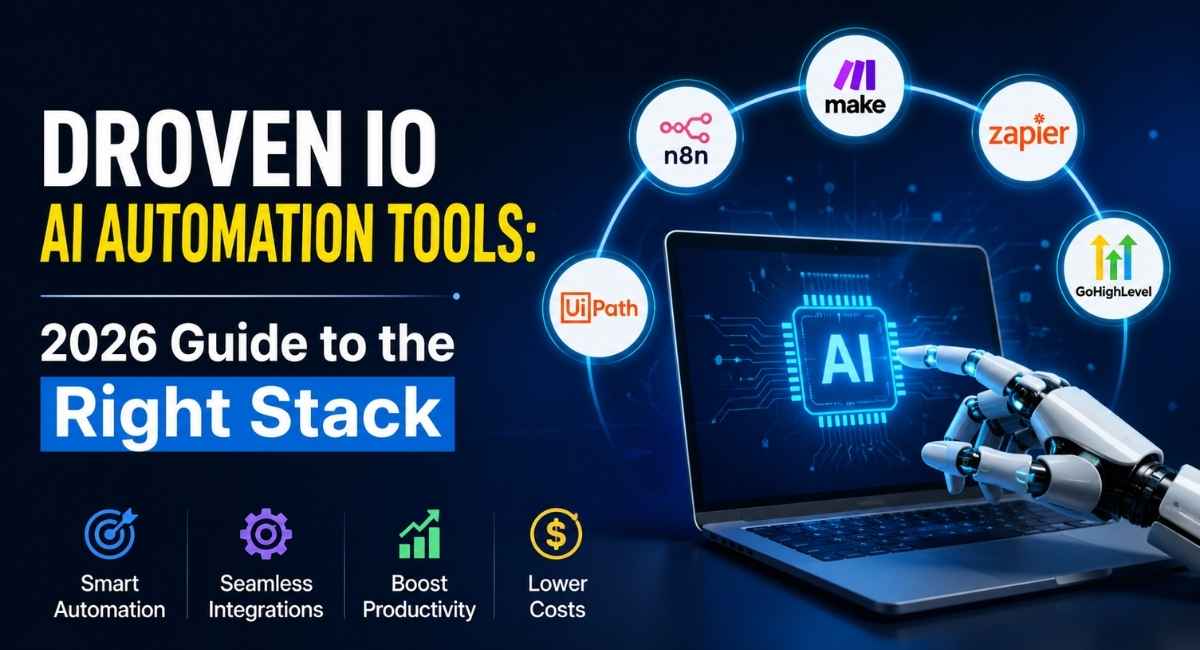
Droven IO AI automation tools are one of the most searched terms among business owners trying to make sense of the crowded automation market. Between workflow platforms, AI chatbots, RPA systems, and CRM automation tools, choosing the right stack has become confusing. This guide explains what Droven.io actually is, which AI automation tools it covers, and how to use that information to build a real automation strategy that works in production, not just in a demo.
Whether you run an ecommerce store, a service business, or an enterprise operations team, this article gives you a clear, practical framework for evaluating AI automation platforms in 2026.
Key Takeaways
- Droven.io is an editorial knowledge platform, not a piece of automation software you install or log into.
- It documents and explains AI automation tools such as n8n, Make, Zapier AI, GoHighLevel, UiPath, and enterprise-scale RPA and CRM systems.
- Droven.io is free to use and does not require an account to read its research.
- Real automation still requires a dedicated workflow automation platform, RPA tool, or AI agent system to execute tasks.
- The right stack depends on your use case, technical capability, budget, and how complex your workflow logic needs to be.
- Businesses that succeed with automation start with one process, validate it, then scale.
Quick Answer
Droven.io is a vendor-neutral AI and automation knowledge platform. It is not software, and it does not build, run, or host automations. If you searched for Droven IO AI automation tools expecting a builder tool, the practical platforms you actually need are n8n, Make, Zapier AI, GoHighLevel, or UiPath, depending on your use case. Droven.io is best used as a research layer before you commit budget to any of these automation engines.
What Is Droven.io?
Droven.io is an independent editorial resource covering artificial intelligence, workflow automation, cloud computing, cybersecurity, and machine learning. It publishes research-backed guides that explain what different categories of automation software actually do, who they serve, and where they typically fail.
Unlike a product marketplace or vendor site, Droven.io does not sell automation software, offer certifications, or maintain affiliate deals with the tools it writes about. It functions more like a technology analyst than a product. The goal is to help business decision-makers understand the automation landscape clearly before they evaluate specific vendors.
In short, Droven.io sits between marketing pages and academic documentation. It explains AI automation platforms, intelligent workflow platforms, and business automation trends in plain language, without pushing a specific product.
What Does “Droven IO AI Automation Tools” Actually Mean?
The phrase is a search category, not a product name. It describes the class of intelligent workflow platforms, automation engines, and AI-powered software that Droven.io researches and documents.
People typing this phrase into Google are usually looking for one of two things:
- What Droven.io itself is and whether it is a usable tool.
- Which specific AI automation tools, RPA systems, or CRM automation platforms are worth adopting.
This distinction matters because confusing the two wastes time. You cannot “sign up” for Droven.io and start automating a workflow. You can, however, use its research to decide between workflow automation platforms like n8n, Make, or Zapier AI before you commit to one.
Is Droven.io a Software Tool You Can Use?
No. Droven.io is not a software product. It does not run automations, connect apps, or offer a visual workflow automation builder. There is no dashboard where you build trigger-action automation or deploy AI agents.
Here is a simple breakdown of what Droven.io is and is not:
| Aspect | Droven.io | Automation Software (n8n, Make, Zapier AI) |
|---|---|---|
| Purpose | Educates and explains | Executes and automates |
| Requires account to build workflows | No | Yes |
| Connects APIs or apps | No | Yes |
| Runs multi-step workflows | No | Yes |
| Offers pricing tiers for automation | No | Yes |
| Best used for | Research and tool selection | Actual deployment |
If your goal is to automate lead capture, customer service, or back-office workflows, you still need a dedicated workflow automation platform, RPA tool, or custom LLM pipeline to do the actual work.
Which AI Automation Tools Does Droven.io Cover?

Droven.io’s editorial coverage spans several categories of automation software. Understanding these categories before picking a tool saves significant time, since choosing within the wrong category is a more common mistake than choosing the wrong specific product.
Workflow Automation Platforms
These tools connect separate applications and trigger automated actions based on defined logic or AI-detected conditions.
- n8n: open-source workflow automation, self-hosted automation, strong for custom API-heavy workflows and developers who want full control over automation architecture.
- Make: visual workflow automation with a flexible, node-based builder suited to complex multi-step automation.
- Zapier AI: the easiest entry point, with over 6,000 app integrations, though costs rise quickly at scale.
- GoHighLevel: combines CRM automation, email, SMS, and lead automation in one platform, which reduces the integration overhead that stalls smaller deployments.
Robotic Process Automation (RPA)
RPA and enterprise automation tools like UiPath and Automation Anywhere handle screen-level task automation, legacy system integration, and structured back-office automation at enterprise scale.
AI-Enhanced CRM and Marketing Automation
Platforms such as HubSpot AI and Salesforce Einstein bring predictive analytics, lead qualification, and automated follow-up directly into CRM automation and marketing automation workflows.
Conversational AI and AI Agents
This category includes AI chatbots, NLP chatbots, and voice agents built on large language models such as GPT-4o, Claude, and Gemini. These systems increasingly rely on RAG-powered knowledge systems, also known as Retrieval-Augmented Generation, to ground responses in real business data instead of hallucinated answers.
Custom LLM Pipelines and Document Intelligence
For businesses with complex document workflows, custom LLM pipelines handle document intelligence, data extraction, and natural language processing tasks that go beyond simple trigger-action automation.
Is Droven.io Legit and Free?
Yes. Droven.io is a legitimate, free-to-read editorial platform. It does not require payment, a subscription, or an account to access its research content. Its content is vendor-neutral, meaning it does not favor one automation software over another for commercial reasons.
That said, “legit” here means legitimate as a research resource, not as a functioning automation platform. If a business expects to build and deploy a working automation directly on Droven.io, that expectation will not be met. It is a reference layer, not an execution layer.
How Do You Use Droven.io in a Real Tool Selection Process?
A practical tool selection process usually follows these steps:
- Process audit: Map the manual, repetitive tasks worth automating, such as lead capture automation, customer service automation, or ecommerce automation.
- Research the category: Use resources like Droven.io to understand whether you need workflow orchestration, RPA, conversational AI, or a combination.
- Assess data quality: Automation depends heavily on clean, structured data. A weak data architecture undermines even the best automation engines.
- Match technical capability to tool: No-code automation platforms like Zapier AI suit non-technical teams, while self-hosted automation like n8n requires developer capability.
- Pilot one workflow: Automate a single high-impact process before expanding to multi-step workflows across departments.
- Test in a sandbox: Validate decision trees, trigger conditions, escalation rules, and fallback paths before production launch.
- Monitor automation KPIs: Track resolution rate, error rate, task completion time, and cost per interaction to measure automation ROI.
This sequence reflects how experienced automation implementers actually work, rather than jumping straight into automation deployment without a process audit.
Automation Selection at a Glance
| Business Need | Recommended Tool Category | Example Platforms |
|---|---|---|
| Simple trigger-action workflows | No-code automation | Zapier AI |
| Complex multi-step automation | Visual workflow automation | Make, n8n |
| CRM and lead automation | AI-enhanced CRM | HubSpot AI, GoHighLevel |
| Enterprise-scale automation | RPA | UiPath, Automation Anywhere |
| Customer-facing conversational AI | LLM-powered chatbots | Custom builds on GPT-4o, Claude, Gemini |
| Document-heavy operations | Document intelligence pipelines | Custom LLM pipelines with RAG |
What Are the Limitations of Droven.io?
Understanding the limitations helps set realistic expectations before relying on it as your only research source.
- No execution capability: It cannot connect your apps, integrate your CRM, or run a live automation.
- No account or dashboard: There is nothing to log into or configure.
- General guidance, not custom architecture: Every business has a different integration architecture, so Droven.io’s educational content should inform, not replace, a proper process design done with your own data.
- Not a substitute for implementation expertise: Automation testing, workflow monitoring, and ongoing maintenance still require either an internal team or a specialist partner.
- Content depth varies by topic: As with any editorial platform, coverage of newer tools or niche use cases may lag behind coverage of mainstream automation software.
Who Should Skip Droven.io?
Droven.io is not the right resource for everyone. Consider skipping it, or using it only as a secondary reference, if you fall into one of these groups:
- You already have deep technical expertise in workflow automation and don’t need an introductory research layer.
- You need vendor-specific pricing, support, or onboarding, which editorial content cannot provide.
- You expect a hands-on builder to create automations directly, rather than reading about categories and comparisons.
- You need compliance-grade or industry-specific automation guidance that requires a specialized consultant rather than general research.
For everyone else, particularly teams early in their automation journey, Droven.io remains a useful starting point for understanding the landscape before spending money on software.
Droven.io vs Other AI Automation Platforms
A common point of confusion is comparing Droven.io directly against tools like Zapier, n8n, or UiPath, as if they compete in the same category. They do not.
| Comparison Point | Droven.io | n8n vs Zapier AI vs Make |
|---|---|---|
| Category | Editorial knowledge platform | Workflow automation platforms |
| Function | Explains automation concepts and tool categories | Builds and runs actual automations |
| Cost model | Free content | Free tiers plus paid usage-based pricing |
| Best fit | Research before buying | Execution after research |
| Hosting | N/A | Cloud workflow automation or self-hosted automation (n8n) |
When people compare n8n vs Zapier AI or Make vs Zapier for their own business, they are making an execution decision. When they read Droven.io, they are making a research decision. Both steps matter, but they are not interchangeable.
Best Practices for Implementing AI Automation Tools
Once you move from research to actual automation implementation, a few practices consistently separate successful deployments from stalled ones.
- Automate one process at a time. Teams that try to automate everything at once tend to lose track of edge cases and break trust with customers.
- Always define a human escalation path. Full autonomy without a clear handoff point is one of the most common failure modes in conversational AI systems.
- Prioritize data quality before automation architecture. Poor CRM integration data quietly breaks entire multi-step workflows.
- Use RAG-powered knowledge systems for customer-facing AI. Retrieval-Augmented Generation reduces hallucination by grounding responses in your live business data and knowledge base.
- Track automation analytics continuously. Resolution rate, escalation rate, and conversion attribution reveal whether an automation is actually delivering positive ROI, not just running.
- Refresh prompts and knowledge base content regularly. Static chatbots degrade in accuracy as products, policies, and pricing change.
Conclusion
Droven IO AI automation tools describe a research category, not a single product. Droven.io itself is a free, vendor-neutral knowledge platform that helps business owners understand automation software, AI agents, RPA, and CRM automation before choosing a specific tool. The actual work of automation still happens inside platforms like n8n, Make, Zapier AI, GoHighLevel, or UiPath, depending on your business size, technical capability, and use case.
The smartest approach in 2026 is to treat Droven.io as your research layer and pair it with a focused pilot on one real workflow. Get clarity first, then build. That sequence, more than any single tool choice, determines whether your automation stack actually reduces operational cost or just adds another subscription to the pile.
Frequently Asked Questions
Is Droven.io free to use?
Yes, Droven.io is free to read. It does not require a paid subscription or account to access its educational content.
Can I build automations directly on Droven.io?
No. Droven.io does not offer a workflow builder. You need a separate platform such as n8n, Make, or Zapier AI to build and run automations.
What is the difference between n8n and Zapier AI?
n8n is open-source and self-hostable, making it cheaper at scale but more technical, while Zapier AI is easier to start with and integrates thousands of apps at a higher recurring cost.
Does Droven.io recommend specific automation vendors?
No. Droven.io is vendor-neutral and does not maintain affiliate relationships, so its coverage aims to be unbiased across tools.
What is RAG in AI automation?
RAG, or Retrieval-Augmented Generation, grounds AI chatbot responses in your actual business documents and live data instead of relying only on general training data.
Which AI automation tool is best for small businesses?
GoHighLevel or Zapier AI typically suit small businesses best because they require less technical setup than self-hosted or enterprise RPA platforms.
How long does it take to see automation ROI?
Many businesses report measurable operational cost reduction within the first 90 days of a well-scoped production deployment, though timelines vary by process complexity.
Is Droven.io the same as an AI automation platform?
No. Droven.io is an editorial knowledge resource, while an AI automation platform is software that actually executes workflows, integrations, and tasks.

Daniel Carter is a digital content writer and researcher at PrimeTechUpdate, specializing in technology, AI, software, business, travel, and digital trends. He focuses on creating accurate, practical, and easy-to-understand content that helps readers make informed decisions. His work emphasizes clarity, reliability, and a reader-first approach.