
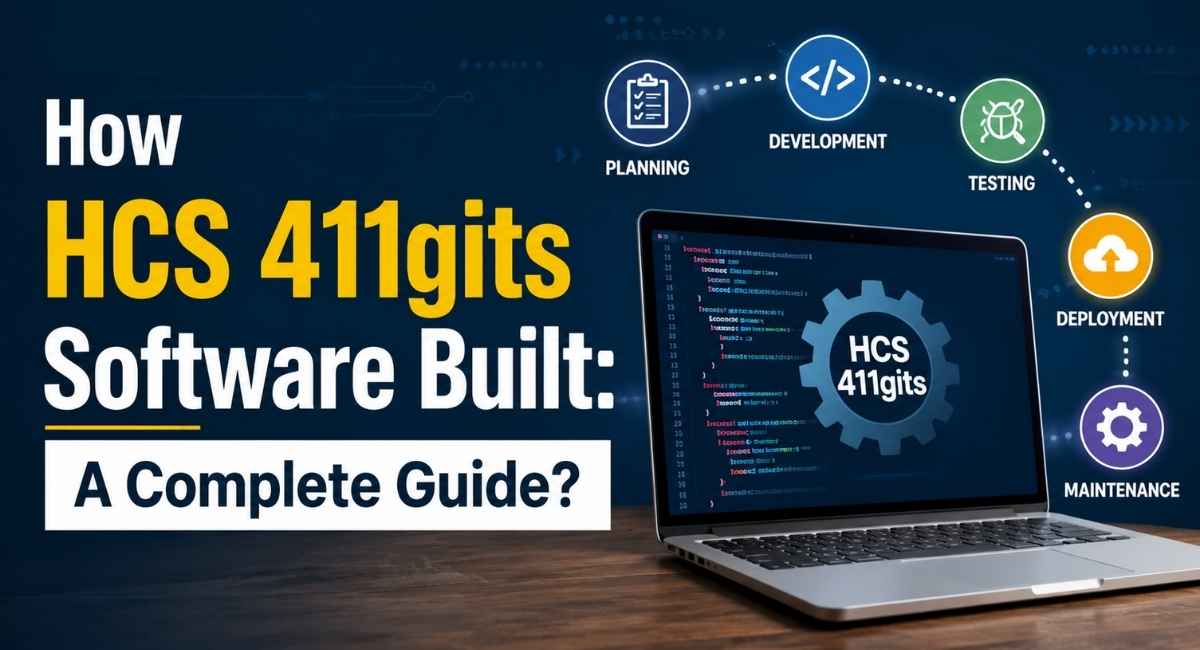
Understanding HCS 411gits software development requires more than looking at the code. A system with workflows, integrations, data processing, security controls, and real-time operations has to be planned, designed, tested, deployed, and maintained as one connected product.
There is an important limitation, however. Public sources do not provide a verified technical specification for the exact HCS 411gits product, and online descriptions differ considerably. Some describe it as an enterprise workflow or calibration-oriented system, while others associate it with traffic and real-time control applications.
Therefore, this guide focuses on the engineering principles that explain how a system of this type would realistically be built. It covers the seven major stages, modular architecture, testing, CI/CD, security, performance optimization, and maintenance without pretending that an unverified technology stack is official.
How HCS 411gits Software Is Built: The Foundation You Need to Understand First
The simplest way to understand the HCS 411gits software build process is to view it as a structured software development lifecycle rather than a single coding project.
A modern system normally moves through a sequence like this:
- Requirements gathering
- Architecture design
- Development
- Testing
- Documentation
- Deployment
- Maintenance
These stages are connected. Requirements influence architecture. Architecture determines how developers organize software components. Development produces code that testing validates. Documentation supports deployment and future maintenance.
For a complex platform, this structure is especially important because different functions may need to work together without becoming tightly dependent on one another.
What the public evidence tells us
The most reliable conclusion from current search results is that HCS 411gits should not be treated as a fully documented mainstream product with a publicly confirmed architecture. Several ranking pages acknowledge this uncertainty, while others make detailed claims without pointing to primary documentation.
That distinction matters for SEO and technical accuracy. A useful explanation should distinguish between:
| Information type | How to treat it |
|---|---|
| Publicly verified documentation | State it as fact |
| Repeated descriptions across secondary sources | Treat cautiously |
| Typical enterprise engineering practice | Present as a likely implementation pattern |
| Specific programming language or framework | Do not claim it is official without evidence |
| Proprietary internal architecture | Cannot be confirmed publicly |
This approach gives readers a practical understanding without turning assumptions into technical facts.
HCS 411gits Software Build Process: The 7 Stages Explained Simply
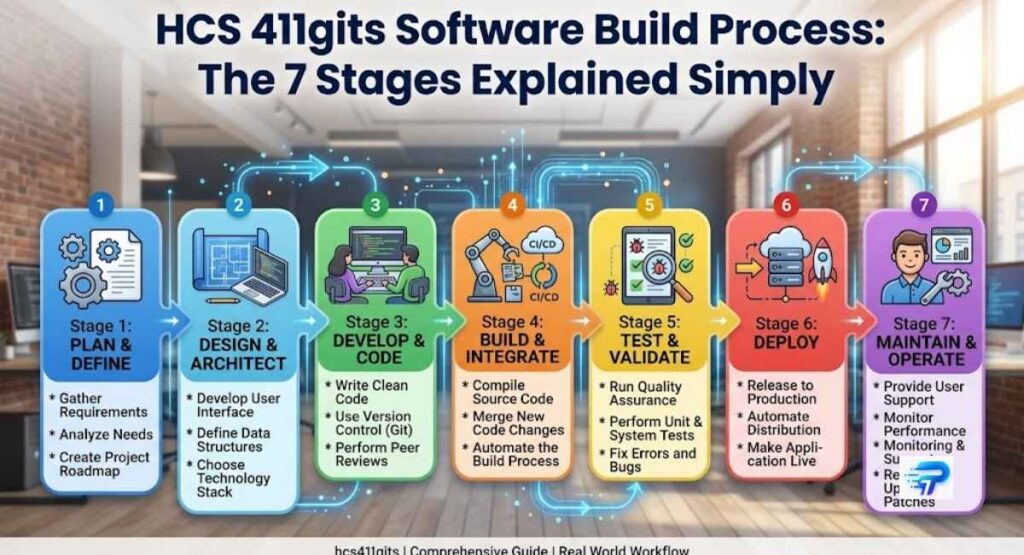
Stage 1 : Requirements Gathering
Every serious HCS 411gits software development project begins by defining the problem before writing code.
During requirements gathering, developers, product owners, analysts, and other stakeholders identify what the system needs to accomplish. The team converts stakeholder requirements into measurable technical requirements.
Typical questions include:
- Who will use the system?
- What workflows must it support?
- What data enters the system?
- What results should it produce?
- Which external systems need API integration?
- What security rules apply?
- What response time is acceptable?
- How much data could the system handle?
- What happens when a service fails?
The output is normally a requirements specification containing functional requirements, non-functional requirements, user stories, use cases, and acceptance criteria.
For complicated workflows, teams may also use flowcharts and UML diagrams to make system behavior easier to understand before development begins.
Good requirements gathering reduces expensive changes later. If developers misunderstand the problem at the beginning, even excellent code can produce the wrong solution.
Stage 2 : Architecture Design
Once requirements are clear, the team creates the technical blueprint.
The HCS 411gits architecture would need to define how the major software components communicate and where responsibilities belong. A layered structure is often useful:
- Presentation layer for the user interface
- Application layer for workflow coordination
- Business logic layer for rules and decisions
- Database layer for persistent information
- Integration layer for APIs and external services
- Security layer for authentication and authorization
- Monitoring layer for logs, alerts, and system health
This is where software architecture design becomes critical.
A team may evaluate whether a modular monolith, service-oriented design, or microservices approach makes the most sense. The right choice depends on workload, team size, operational complexity, system scalability requirements, and maintenance needs.
Technology choices should also come from requirements rather than fashion. React.js, Angular, or Vue.js could support frontend development, while Python, Java, or Node.js could support backend development in a typical modern stack. PostgreSQL or MongoDB could serve different database requirements.
Those examples describe possible engineering choices, not confirmed technologies inside HCS 411gits.
Stage 3 : Development
Development turns the approved architecture into working software.
Frontend developers build screens, dashboards, forms, navigation, and other elements of the user interface. Backend developers implement business logic, authentication, data processing, APIs, and system services.
A typical development workflow might include:
- Creating a feature branch in Git
- Implementing a small, testable change
- Writing unit tests
- Performing code reviews
- Running automated checks
- Merging approved changes
- Building a deployable artifact
Version control is essential because multiple developers may work on different parts of the system simultaneously. Git is commonly paired with GitHub or GitLab for repository management and collaboration.
For larger teams, development standards may define naming conventions, branching rules, testing expectations, security checks, and review requirements.
The goal is not simply to produce more code. It is to produce code that remains understandable when another developer needs to modify it months later.
Stage 4 : Testing
Testing determines whether the software behaves correctly under expected and unexpected conditions.
A mature HCS 411gits software build process would normally use multiple levels of testing rather than relying on one final check.
| Testing type | Main purpose |
|---|---|
| Unit testing | Tests individual functions or components |
| Integration testing | Checks communication between components |
| System testing | Validates the complete application |
| Performance testing | Measures speed and resource behavior |
| Security testing | Identifies vulnerabilities and access weaknesses |
| User acceptance testing | Confirms the system meets practical requirements |
Automated testing can be implemented with tools such as JUnit, PyTest, or Jest depending on the language and framework.
Performance testing can measure response time, CPU usage, memory management, throughput, and behavior under concurrent workloads.
Security testing should examine authentication, authorization, input validation, encrypted data transmission, dependency vulnerabilities, and inappropriate access.
For systems handling sensitive operational information, role-based access control can restrict features and data according to user responsibilities.
Testing is strongest when it happens throughout development rather than being postponed until the final week.
Stage 5 : Documentation
Documentation is often underestimated because it does not visibly change the software.
In reality, technical documentation is part of the product’s long-term reliability.
Useful documentation can cover:
- System architecture
- API behavior
- Database structure
- Installation procedures
- Configuration settings
- Deployment instructions
- Security procedures
- Troubleshooting steps
- Backup and recovery processes
- Release notes
Good documentation reduces dependence on individual developers. If the person who originally created a module leaves the team, another engineer should still be able to understand its purpose and operation.
Documentation should also evolve with the code. Outdated documentation can be almost as harmful as having no documentation.
Stage 6 : Deployment
Deployment moves tested software into an environment where real users or operational systems can access it.
Modern cloud deployment may use containerization with Docker and orchestration platforms such as Kubernetes when the workload requires that level of infrastructure.
Possible cloud environments include AWS, Microsoft Azure, or Google Cloud. Again, these are common industry options rather than confirmed HCS 411gits infrastructure.
A controlled deployment process may include:
- Build the application
- Run automated tests
- Scan dependencies and containers
- Create a release artifact
- Deploy to staging
- Validate critical workflows
- Release to production
- Monitor system health
- Roll back if necessary
This is where a CI/CD pipeline becomes valuable.
Continuous integration automatically validates code changes as they enter the shared codebase. Continuous deployment can automate delivery after required checks succeed.
Stage 7 : Maintenance
Software is never truly finished when it reaches production.
The final stage of the HCS 411gits development lifecycle is ongoing software maintenance. Developers monitor the application, correct defects, improve performance, respond to user feedback, and apply security patches.
Maintenance commonly includes:
- Bug fixes
- Software updates
- Security patches
- Dependency upgrades
- Performance improvements
- Database maintenance
- Monitoring improvements
- Compatibility changes
- Feature enhancements
Tools such as Grafana or Nagios can be used in appropriate environments to monitor metrics, service health, and operational behavior.
Maintenance also closes the development loop. Production data and user feedback can reveal problems that were not visible during initial testing.
The Modular Architecture Advantage in HCS 411gits
HCS 411gits modular architecture is best understood as a design strategy in which different responsibilities are separated into manageable components.
Instead of placing every function into one large codebase, developers establish boundaries between software components.
For example:
User Interface
      |
Application Services
      |
Business Logic
      |
Integration Layer
      |
Database and Data Services
      |
Monitoring and Security
The exact structure can differ, but the principle remains useful.
Why modular design matters
A modular system can make it easier to:
- Replace one component without rewriting everything
- Test individual services
- Scale heavily used functions
- Assign ownership to development teams
- Isolate failures
- Apply security controls
- Maintain older functionality while adding new features
This becomes particularly valuable in enterprise software development, where complex workflows often evolve over many years.
Modularity does not automatically mean microservices. A well-designed modular monolith can also provide strong separation while avoiding the operational complexity of dozens of independent services.
How HCS 411gits Software Build Quality Is Maintained Through Testing and CI/CD
Quality is created through repeated verification, not a single final inspection.
A robust CI/CD pipeline can automatically perform checks whenever developers submit code. A simplified flow looks like this:
Code Change
    ↓
Version Control
    ↓
Build
    ↓
Unit Tests
    ↓
Integration Tests
    ↓
Security Checks
    ↓
Deployment to Staging
    ↓
Production Deployment
    ↓
Monitoring
Jenkins and CircleCI are examples of CI/CD platforms that can automate portions of this workflow.
Code reviews provide another quality layer. A second developer can identify logic problems, security concerns, unnecessary complexity, or missing tests before the change reaches production.
The strongest process combines automated checks with human judgment.
Key Performance Optimization Techniques Used in HCS 411gits Development
Performance optimization should begin with measurement.
Developers should first identify the actual bottleneck instead of optimizing code based on assumptions.
Important techniques include:
Database indexing
Database indexing can reduce the amount of data the database must scan for frequently used queries. Indexes should be selected carefully because excessive indexing can increase storage and write overhead.
Query optimization
Slow database queries can increase response time throughout the application. Developers can inspect execution plans, improve query structure, retrieve only necessary fields, and reduce unnecessary database calls.
Caching mechanisms
Frequently requested information can sometimes be cached to reduce repeated processing and database load.
Caching is particularly useful when data changes less frequently than it is read.
Connection pooling
Creating a new database connection for every request can be inefficient. Connection pooling allows applications to reuse established connections and reduce connection overhead.
Code profiling
Code profiling helps identify functions consuming excessive CPU time or memory. Profiling is more reliable than guessing which part of an application is slow.
Real-time data processing
Systems that handle real-time data processing need efficient event handling, controlled memory usage, appropriate queues, and careful monitoring of response time.
System scalability
Scalability means the system can handle increasing demand without unacceptable degradation.
Possible strategies include:
- Horizontal scaling
- Load balancing
- Asynchronous processing
- Database optimization
- Caching
- Queue-based workloads
- Independent scaling of heavy services
Performance work should always be measured against meaningful metrics such as response time, throughput, CPU usage, memory consumption, and error rate.
The Engineering Decisions That Shape HCS 411gits Reliability
Reliability is not created by one tool. It comes from many engineering decisions working together.
The most important decisions include:
Clear boundaries: Each module should have a well-defined responsibility.
Failure handling: Developers should anticipate network failures, unavailable services, invalid input, and database problems.
Security by design: Security protocols should be considered during architecture rather than added after release.
Observability: Logs, metrics, traces, and alerts make failures easier to diagnose.
Reproducible builds: Development and production environments should be consistent enough to reduce deployment surprises.
Controlled releases: Changes should move through validation stages before reaching production.
For systems with authentication requirements, OAuth 2.0 can be used where appropriate for delegated authorization, while TLS protects data transmitted between systems.
These practices help turn a functional application into dependable software.
Common Build Risks and How Teams Reduce Them
Complex software can fail even when individual components work correctly.
| Risk | Practical response |
|---|---|
| Unclear requirements | Document use cases and acceptance criteria |
| Architecture becoming too complex | Keep module boundaries explicit |
| Integration failures | Use integration tests and contract checks |
| Slow database queries | Apply indexing and query optimization |
| Security vulnerabilities | Perform security testing and dependency scanning |
| Deployment failures | Use staging and automated CI/CD checks |
| Poor maintainability | Require code reviews and documentation |
| Unexpected production load | Perform performance and scalability testing |
| Knowledge concentrated in one person | Maintain technical documentation |
| Repeated operational failures | Use monitoring, logs, and post-incident reviews |
The important lesson is that prevention is usually cheaper than repair. A small design decision made during architecture can prevent a much larger problem after deployment.
Frequently Asked Questions
What is HCS 411gits software?
HCS 411gits is a term used online for a software system described in several different ways, but its exact official identity and internal architecture are not clearly documented by a primary public source.
How is HCS 411gits software built?
A realistic build model follows requirements gathering, architecture design, development, testing, documentation, deployment, and maintenance.
What architecture is suitable for HCS 411gits?
A modular architecture is a practical choice for complex software because it separates responsibilities and makes individual components easier to test, maintain, and scale.
Which programming languages are used?
There is no reliable public evidence confirming a specific official programming language stack for HCS 411gits. Python, Java, and Node.js are common backend choices for comparable systems.
Why is CI/CD important?
CI/CD automates repetitive build, testing, and deployment checks, helping development teams deliver changes more consistently and catch problems earlier.
How is software performance improved?
Common techniques include database indexing, query optimization, caching mechanisms, connection pooling, code profiling, and workload-specific scalability improvements.
How does security fit into development?
Security should be considered from requirements and architecture through testing and production monitoring, including authentication, authorization, encrypted data transmission, and security patches.
Is HCS 411gits a verified commercial product?
The exact HCS 411gits label is not supported by clear primary documentation in the current public search results. Some pages explicitly identify the term as difficult to verify, while others provide conflicting descriptions.
Final Thoughts
The clearest way to understand HCS 411gits software development is to focus on the engineering process rather than unsupported claims about a proprietary technology stack. A dependable system begins with requirements, gains structure through architecture, becomes functional through development, earns trust through testing, and remains useful through deployment and maintenance.
The seven stages are not isolated checkpoints. They form a continuous cycle in which user feedback, monitoring data, security findings, and production experience influence future improvements. That disciplined approach is what allows complex software to remain maintainable, secure, performant, and scalable over time.
For readers researching HCS 411gits, the most trustworthy conclusion is also the simplest: verify product-specific claims against primary documentation, but use established software engineering principles to understand how a system of this complexity is built.

Daniel Carter is a digital content writer and researcher at PrimeTechUpdate, specializing in technology, AI, software, business, travel, and digital trends. He focuses on creating accurate, practical, and easy-to-understand content that helps readers make informed decisions. His work emphasizes clarity, reliability, and a reader-first approach.