
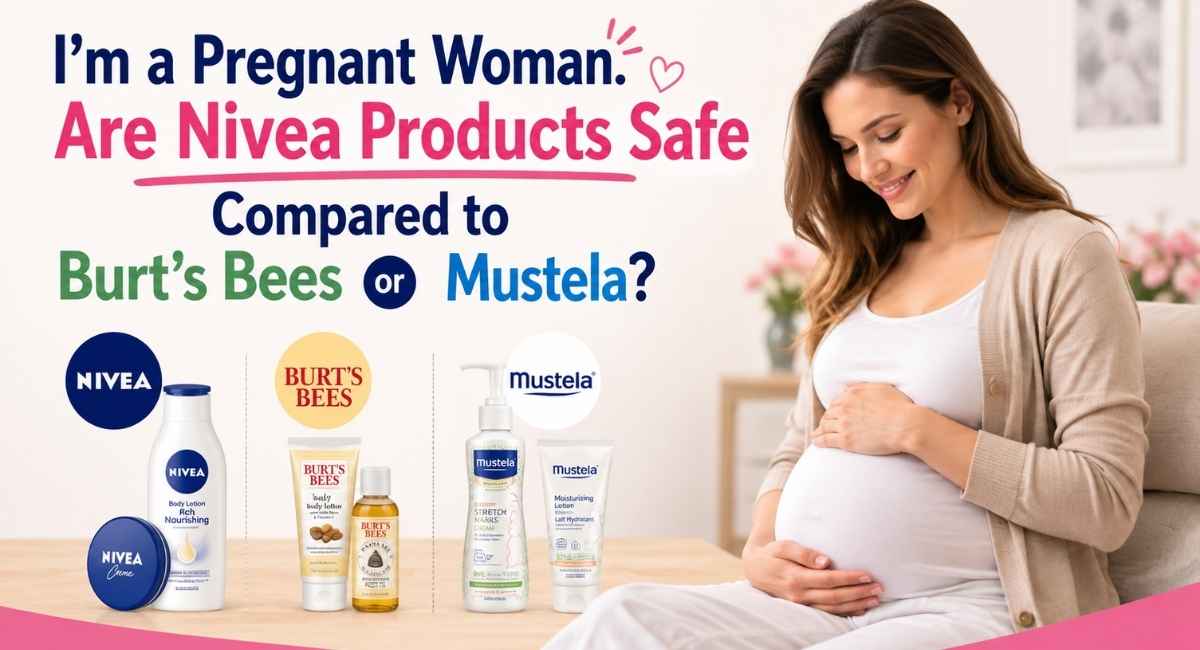
Pregnancy changes skin in ways that are hard to predict. Some women deal with dryness, others notice sensitivity, itching, or stretch marks, and most become more cautious about what they put on their skin. That’s exactly why a pregnant woman comparing Nivea, Burt’s Bees, and Mustela wants a straight answer, are Nivea products safe compared to Burt’s Bees or Mustela, or is one brand actually built with pregnancy in mind?
All three are popular, but they weren’t designed with the same priorities. Nivea focuses on general skincare, Burt’s Bees leans on naturally derived ingredients, and Mustela centers on maternal and baby care. Knowing that difference makes shopping far less confusing.
Nivea vs Burt’s Bees vs Mustela: Quick Comparison
Each brand takes a different approach to skincare, and that shows up the moment you compare them side by side.
| Brand | Built for pregnancy? | Ingredient style | Best for | Typical price |
|---|---|---|---|---|
| Nivea | No, general skincare | Mixed: some fragrance-free, some fragranced, some with actives | Everyday moisturizing on a budget | $ (affordable) |
| Burt’s Bees | No, but naturally derived | Botanical oils, beeswax, plant-based ingredients | Fans of naturally derived formulas | $$ (mid-range) |
| Mustela | Yes, maternity-focused line | Fragrance-free or low-allergen, dermatologist-tested | Stretch marks, sensitive skin, belly care | $$$ (higher) |
Nivea wins on affordability and variety. Burt’s Bees appeals to people who want plant-derived ingredients over synthetic ones. Mustela is the only one of the three built specifically around pregnancy and baby skincare, which shows in both its formulas and its price tag.
None of this means Nivea or Burt’s Bees are unsafe. It just means you’ll need to check individual products more carefully with those two brands, while Mustela does more of that filtering for you.
Why Does Pregnancy Change Your Skincare Needs?
Pregnancy hormones, mainly estrogen and progesterone, change how your skin behaves almost from the first trimester.
Skin often gets drier because hormonal shifts affect oil production and how well the skin barrier holds onto moisture. For some women it’s the opposite: skin gets oilier and more prone to breakouts. Either way, the skin barrier is working differently than it did before.
As your belly, hips, and breasts expand, the skin stretches faster than it’s used to. This is where stretch marks, itching, and a tight or uncomfortable feeling usually come from. Elasticity gets tested, and dry skin makes that stretching feel worse.
Pregnancy also increases skin sensitivity. Products you used without issue before can suddenly cause irritation, redness, or breakouts. Hormonal changes can even trigger patches of hyperpigmentation, known as melasma.
Because of all this, a routine that worked pre-pregnancy doesn’t always hold up. Your skin usually needs:
- More consistent hydration
- Gentler, fragrance-light or fragrance-free formulas
- Barrier-support ingredients like glycerin, panthenol, or shea butter
- Fewer active ingredients that could irritate more reactive skin
This is the backdrop for why pregnancy-safe skincare matters. It’s not only about avoiding harmful ingredients. It’s about matching products to skin that’s genuinely behaving differently than before.
Which Skincare Ingredients Should Pregnant Women Avoid?
Some ingredients are commonly flagged by doctors and dermatologists as ones to avoid or limit during pregnancy. This isn’t a complete medical list, and you should always confirm specifics with your OB, but it covers the ingredients that come up most often.
| Ingredient | Commonly found in | Why it’s flagged |
|---|---|---|
| Retinoids/retinol | Anti-ageing products, acne products | Linked to birth defects in high doses; avoided as a precaution |
| Salicylic acid (high %) | Exfoliating products, acne treatments | Oral use is linked to risk; topical high-dose use is generally avoided |
| Hydroquinone | Brightening products | High absorption rate; avoided during pregnancy |
| Formaldehyde-releasing preservatives | Some lotions, nail products | Linked to potential toxicity concerns |
| Certain essential oils in concentration | Fragranced skincare, aromatherapy products | Some are avoided in high doses, though many are fine in small amounts |
| Phthalates | Fragranced products | Linked to hormone disruption |
| Oxybenzone | Some chemical sunscreens | Some doctors recommend mineral sunscreen filters instead |
A few points worth keeping in mind:
- Product category matters. A treatment product used on a small area is different from a body lotion applied daily over large areas.
- Concentration matters. Many “flagged” ingredients appear in trace amounts in everyday products and aren’t the same risk as a prescription-strength treatment.
- Natural does not mean safer. Some essential oils and botanical extracts are just as capable of triggering irritation or sensitivity as synthetic ingredients.
If you’re ever unsure about a specific active ingredient, that’s a conversation worth having with your doctor rather than guessing.
How Can You Check if a Skincare Product Is Pregnancy-Safe?
Checking a product doesn’t have to be complicated, but it does help to have a system.
Start with the ingredient list, not the brand name. Pregnancy-safe skincare isn’t decided by which company makes it. It’s decided by what’s actually in the formula.
Look at product category and use area.
- Daily use, large-area products (body lotion, cleansing gel) deserve closer attention since exposure adds up
- Small-area, occasional-use products (lip balm, spot treatment) carry lower relative exposure
- Leave-on products generally matter more than rinse-off products
Cross-check ingredients individually. Search each active ingredient rather than assuming the whole product is fine or risky based on one component.
Use a pregnancy-safety checker tool or app. Several free tools let you scan or search a product’s ingredient list and flag anything worth discussing with your doctor.
Watch for regional formula differences. The same product name can have a different ingredient list depending on the country it’s sold in, so don’t assume a formula is identical everywhere.
When in doubt, ask your OB or dermatologist. This matters most for active ingredients, treatment products, or anything applied regularly over a large area.
A simple habit works well here: check the ingredient list before you buy, not after you’ve already been using the product for weeks.
Are Nivea Products Generally Safe During Pregnancy?
Most Nivea products are fine to use during pregnancy, especially the basic fragrance-free moisturizers and body lotions found in lines like Nivea Creme or Nivea Soft. These formulas rely on simple ingredients such as glycerin and mineral oil, without the active ingredients that typically raise concern.
The exceptions are Nivea’s treatment-style products. Anti-ageing creams with retinol, certain firming products, and some fragranced body sprays are worth checking individually. Nivea doesn’t market itself as a pregnancy-safe brand, so it’s on you to check the ingredient list product by product rather than assuming the whole range is cleared for use.
Are Burt’s Bees Products Designed With Pregnancy in Mind?
Burt’s Bees built its reputation on naturally derived ingredients like beeswax, botanical oils, and plant extracts, which gives many of its products a gentle profile. Items like the classic Beeswax Lip Balm or fragrance-light body lotions are generally considered low-risk during pregnancy.
But naturally derived doesn’t mean automatically safe. Some Burt’s Bees products contain essential oils and fragrance blends in concentrations worth noting if you have sensitive skin or are prone to irritation during pregnancy. Like Nivea, Burt’s Bees isn’t formulated specifically for pregnancy, so its “safe” products earn that label case by case, not because of the brand name.
Is Mustela More Focused on Pregnancy Care?
Yes, and this is where Mustela separates itself from the other two. The brand’s Maternity line, including its stretch mark cream and belly oil, is developed specifically for pregnancy skin, with formulas that are typically fragrance-free or built around low-allergen fragrance and dermatologist-tested claims.
Mustela also draws on its baby skincare background, applying the same gentle, barrier-focused approach to maternal products. That specialization is reflected in the price, but it also means less label-checking is needed since pregnancy safety is built into the product design from the start rather than something you have to verify yourself.
Nivea vs Burt’s Bees vs Mustela: Key Differences
The core difference comes down to intent. Nivea is a general skincare brand where pregnancy-safe options exist within a much wider, non-pregnancy-focused range. Burt’s Bees sits in a similar spot, just built around naturally derived ingredients instead of standard cosmetic formulas.
Mustela is the only brand of the three designed around pregnancy and infant skin from the ground up. That shows up in ingredient choices, fragrance levels, and product categories like belly-specific stretch mark care.
| Factor | Nivea | Burt’s Bees | Mustela |
|---|---|---|---|
| Designed for pregnancy | No | No | Yes |
| Ingredient approach | Mixed, cosmetic-standard | Naturally derived, botanical | Fragrance-free/low-allergen, dermatologist-tested |
| Product range | Very wide, general skincare | Moderate, naturally focused | Focused on maternity and baby |
| Label-checking needed | Yes, product by product | Yes, product by product | Minimal, built for pregnancy |
| Price point | Budget-friendly | Mid-range | Higher-end |
Choose Nivea if you want:
- An affordable, easy-to-find option for daily moisturizing
- A wide range of product types, from lotions to cleansing gels
- Simple, fragrance-free formulas for everyday hydration
- A brand you can buy almost anywhere without special ordering
Choose Burt’s Bees if you want:
- Naturally derived, plant-based ingredients over synthetic ones
- Beeswax and botanical oil-based body balms and lip care
- A gentle skincare routine with a naturally derived feel
- Mid-range pricing without going into premium territory
Choose Mustela if you want:
- Products designed specifically for pregnancy and belly care
- Dedicated stretch mark prevention and treatment options
- Fragrance-free or low-allergen formulas for sensitive pregnancy skin
- Less time spent checking ingredient lists yourself
Nivea vs Burt’s Bees vs Mustela Ingredients During Pregnancy
The clearest way to compare these three brands is by ingredient pattern, not marketing language. Nivea leans on classic cosmetic ingredients like glycerin, mineral oil, and panthenol, with occasional actives in specific product lines. Burt’s Bees builds around beeswax, shea butter, and botanical oils, giving its formulas a naturally derived base.
Mustela uses fragrance-free or low-allergen formulas with ingredients like avocado-based ingredients, glycerin, and panthenol, chosen specifically for barrier support and skin elasticity. None of the three brands are ingredient-identical, so checking the exact formula still matters even within this general pattern.
| Ingredient type | Nivea | Burt’s Bees | Mustela |
|---|---|---|---|
| Base moisturizers | Glycerin, mineral oil | Shea butter, beeswax | Glycerin, avocado-based ingredients |
| Fragrance | Often fragranced | Light, botanical fragrance | Mostly fragrance-free |
| Actives | Present in some lines | Minimal | Rare, avoided by design |
| Essential oils | Occasional | Common | Limited or none |
Nivea vs Burt’s Bees vs Mustela for Dry Pregnancy Skin
Dry pregnancy skin needs consistent hydration and ingredients that support the skin barrier rather than just sitting on the surface. Nivea’s basic moisturizers, especially the Nivea Creme and Soft ranges, handle everyday dryness well thanks to glycerin and mineral oil.
Burt’s Bees performs similarly, with shea butter and beeswax offering a heavier, more occlusive feel that some people prefer for very dry patches. Both work, though texture and skin type will decide which feels better in daily use.
Slight Edge: Mustela
Mustela’s Hydra Bebe and Maternity moisturizers are formulated specifically for pregnancy-related dryness, combining glycerin with avocado-based ingredients for deeper barrier support. The difference isn’t dramatic, but the formulas are more targeted.
For daily moisturization on already-sensitive or fast-changing skin, that targeted approach gives Mustela a slight practical edge, even if Nivea and Burt’s Bees remain perfectly workable options for general dryness.
Nivea vs Burt’s Bees vs Mustela for Sensitive Pregnancy Skin
Sensitive pregnancy skin reacts more easily to fragrance, essential oils, and certain preservatives. Nivea’s fragrance-free lines are generally gentle, but several of its popular products do contain fragrance, which can be a problem for reactive skin.
Burt’s Bees carries a similar risk in the opposite direction. Its naturally derived formulas often include botanical fragrance and essential oils, which can trigger irritation in some pregnant women even though the ingredients are plant-based.
Winner: Mustela
Mustela’s fragrance-free and low-allergen formulas are built with skin sensitivity in mind from the start, not adjusted after the fact. That makes it the more reliable pick for pregnant women dealing with heightened reactivity or a history of sensitive skin.
This is one of the clearer gaps between the three brands. Nivea and Burt’s Bees both require label-checking for sensitivity, while Mustela’s core maternity products are designed to avoid the issue altogether.
Nivea vs Burt’s Bees vs Mustela for Stretch Marks
Stretch mark care is about supporting skin elasticity and hydration as the belly and other areas stretch. Nivea offers general firming and elasticity products, but few are marketed specifically for stretch mark prevention during pregnancy.
Burt’s Bees has a small selection of belly-focused balms with botanical oils, which help with hydration but aren’t positioned as dedicated stretch mark treatments in the way some other brands are.
Winner: Mustela
Mustela’s Stretch Marks Cream and belly oil are formulated specifically for this purpose, combining ingredients aimed at improving elasticity with consistent daily use. This is Mustela’s most specialized category among the three brands.
If stretch mark prevention is your main priority, Mustela’s dedicated product line makes it the more targeted choice, while Nivea and Burt’s Bees work better as general moisturizers than stretch-mark-specific treatments.
Nivea vs Burt’s Bees vs Mustela Price Comparison
Price is where the gap between these three brands is most obvious. Nivea sits firmly in the budget category, with body lotions and creams often costing a few dollars per bottle. Burt’s Bees is mid-range, priced higher than Nivea but still accessible for regular use.
Mustela costs noticeably more, reflecting its specialized formulas and maternity-specific product development. For many pregnant women, that price difference becomes the deciding factor between the three brands.
| Brand | Typical price range | Value positioning |
|---|---|---|
| Nivea | $3 to $10 | Budget, everyday use |
| Burt’s Bees | $8 to $18 | Mid-range, naturally derived |
| Mustela | $15 to $35+ | Premium, pregnancy-specialized |
Nivea vs Burt’s Bees vs Mustela: Pros and Cons
Each brand comes with trade-offs worth weighing before you decide. Here’s how they stack up.
Nivea Pros
- Affordable and widely available
- Wide range of product types and formulas
- Simple, fragrance-free options exist across most lines
- Familiar brand with a long safety track record
Nivea Cons
- Not formulated specifically for pregnancy
- Some products contain fragrance or active ingredients worth checking
- Requires product-by-product label checking
Burt’s Bees Pros
- Naturally derived, plant-based ingredient focus
- Popular lip care and balm products with minimal risk
- Mid-range pricing, more accessible than premium brands
- Recognizable, naturally derived formulas
Burt’s Bees Cons
- Botanical fragrance and essential oils can irritate sensitive skin
- Not designed specifically for pregnancy
- Fewer targeted options for stretch marks or belly care
Mustela Pros
- Formulated specifically for pregnancy and maternal skincare
- Fragrance-free or low-allergen formulas across most products
- Dedicated stretch mark and belly care line
- Less label-checking required overall
Mustela Cons
- Higher price point than the other two brands
- Smaller general skincare range outside maternity products
- Not as widely available in every store
Nivea vs Burt’s Bees vs Mustela: Which One Should You Choose?
If budget and convenience matter most, Nivea’s basic, fragrance-free moisturizers cover daily hydration needs without much fuss. It won’t offer pregnancy-specific formulations, but for general dry pregnancy skin, it gets the job done affordably.
If you prefer naturally derived ingredients and don’t have particularly sensitive skin, Burt’s Bees fills that middle ground well. For sensitive skin, stretch mark prevention, or simply wanting fewer ingredients to double-check, Mustela’s maternity-focused formulas make it the more specialized, if pricier, choice.
Final Verdict: Are Nivea Products Safe Compared to Burt’s Bees or Mustela?
Nivea products are generally safe during pregnancy, and so are most Burt’s Bees products, as long as you check the specific formula rather than assuming brand-wide safety. Neither brand is built around pregnancy, so that extra step of reading the ingredient list matters more with these two.
Mustela stands apart because pregnancy safety is part of its design rather than something layered on afterward. It costs more, but for sensitive skin, stretch marks, or simply wanting one less thing to worry about, that specialization is where the price difference earns its keep.
Frequently Asked Questions
Is Nivea Creme safe to use during pregnancy?
Yes, Nivea Creme is generally considered safe during pregnancy. Its core ingredients, including glycerin and mineral oil, don’t include the actives typically flagged as risky.
Can I use Burt’s Bees Beeswax Lip Balm while pregnant?
Yes, Burt’s Bees Beeswax Lip Balm is widely considered safe during pregnancy. It’s a small-area, occasional-use product with a simple, naturally derived ingredient list.
Why is Mustela more expensive than Nivea or Burt’s Bees?
Mustela’s higher price reflects its specialized, dermatologist-tested formulas developed specifically for pregnancy and baby skincare, rather than general cosmetic use.
Do I need to avoid all fragranced skincare products during pregnancy?
Not necessarily. Fragrance isn’t automatically unsafe, but it’s a common trigger for skin sensitivity during pregnancy, so fragrance-free options are often more comfortable for reactive skin.
Are natural or organic skincare brands automatically safer during pregnancy?
No. Naturally derived ingredients like essential oils can still cause irritation or aren’t always pregnancy-safe. Always check the exact ingredient list rather than relying on “natural” labeling alone.

Daniel Carter is a digital content writer and researcher at PrimeTechUpdate, specializing in technology, AI, software, business, travel, and digital trends. He focuses on creating accurate, practical, and easy-to-understand content that helps readers make informed decisions. His work emphasizes clarity, reliability, and a reader-first approach.