
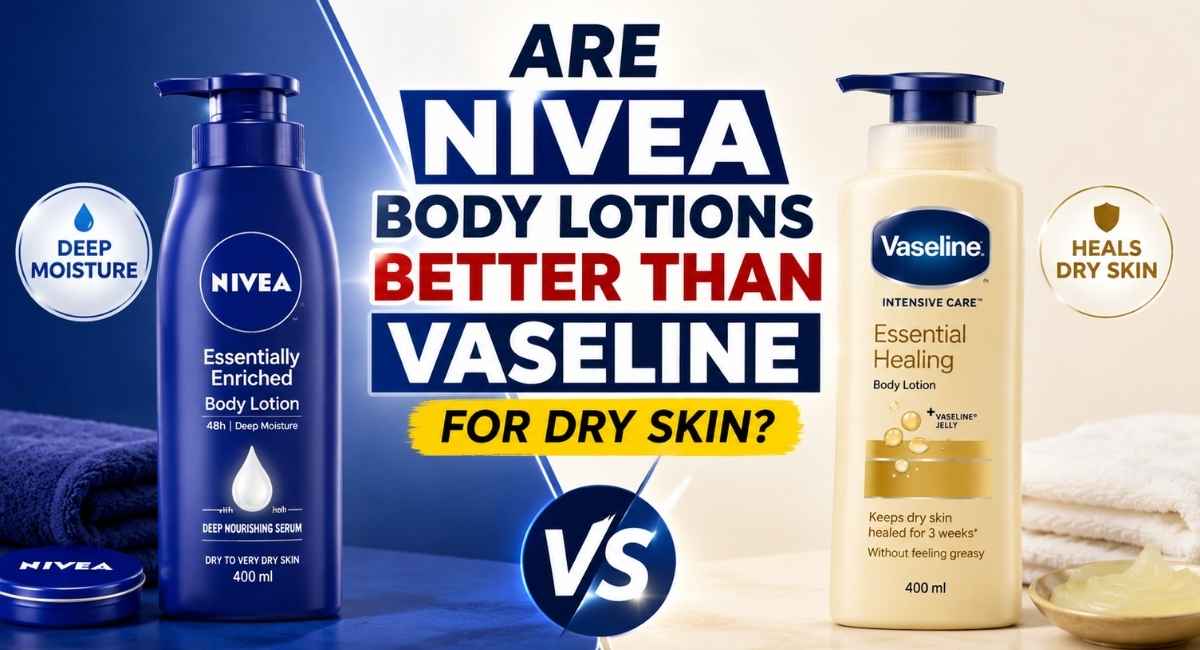
Your skin feels tight the second you step out of the shower. By afternoon, your elbows look ashy and your shins have that dull, flaky texture no amount of scrolling through skincare TikToks seems to fix. So you stand in the aisle staring at two familiar blue bottles, wondering the same thing every guy eventually asks: are Nivea body lotions better than Vaseline for dry skin, or is one just hype?
Here’s what nobody tells you upfront. Nivea and Vaseline aren’t even doing the same job. One pumps moisture into your skin. The other traps whatever moisture is already there. That single difference explains why one works better in July and the other saves you in January, and why the real answer depends entirely on how dry your skin actually is.
Nivea Body Lotions vs Vaseline for Dry Skin: Quick Comparison
If you’re standing in the skincare aisle wondering whether Nivea body lotions are better than Vaseline for dry skin, the short answer is: it depends on how dry your skin actually is, but both deserve a spot in your routine for different reasons.
Nivea works by pulling moisture into your skin and keeping it there, which makes it a solid pick for everyday hydration. Vaseline works differently, it seals your skin’s surface so water can’t escape, which makes it the stronger option when your skin is cracked, flaking, or genuinely struggling. Neither one is “the winner” across the board. The right choice comes down to what your skin needs on a given day.
| Nivea Body Lotion | Vaseline | |
|---|---|---|
| Best for | Normal to moderately dry skin | Very dry, cracked, or rough skin |
| How it works | Adds hydration (humectant + emollient) | Locks in existing moisture (occlusive) |
| Texture | Lightweight, non-greasy, creamy | Thicker, more of a protective seal |
| Absorption | Fast | Slower, sits on the surface |
| Best time to use | Morning, after showering | Night, or on specific rough patches |
| Feel through the day | Soft, no residue | Slightly heavier, very long-lasting |
Nivea Body Lotions vs Vaseline for Dry Skin: What Is the Main Difference?
The core difference isn’t about which brand is “stronger.” It’s about what each product actually does to your skin. Nivea body lotion is designed to add moisture, while Vaseline is designed to trap the moisture that’s already there.
This is why the two feel so different in daily use. Nivea sinks in and disappears within minutes because it’s mostly water based, working with your skin rather than sitting on top of it. Vaseline stays visible longer because it’s pure petroleum jelly, forming a physical layer that stops water from escaping instead of adding any water itself.
| Nivea Body Lotion | Vaseline | |
|---|---|---|
| What it does | Hydrates the skin | Seals in existing moisture |
| Main category | Humectant + emollient | Occlusive |
| Water content | Contains water | Contains no water |
| Works best when | Skin needs added moisture | Skin has moisture but keeps losing it |
Nivea vs Vaseline for Dry Skin: Which Ingredients Matter Most?
Nivea‘s formulas typically lean on glycerin, mineral oil, and sweet almond oil, sometimes with added vitamin E or hyaluronic acid depending on the range. Glycerin is the real workhorse here. It’s a humectant, meaning it pulls water into the outer layer of your skin, while the oils and emollients smooth rough texture and keep that moisture from evaporating too quickly.
Vaseline‘s ingredient list is far shorter because it’s built around one thing: petrolatum. Vaseline Intensive Care lotions add stearic acid and some emollients to make the texture more wearable, but the petrolatum is still doing most of the barrier repair work. That simplicity is actually a strength for anyone with sensitive or fragrance-reactive skin.
- Nivea’s key players: glycerin, mineral oil, sweet almond oil, cocoa butter, vitamin E
- Vaseline’s key player: petrolatum, supported by stearic acid in lotion formulas
- Shared ground: both brands offer fragrance-free versions for sensitive skin
Nivea Body Lotions vs Vaseline for Dry Skin: Which Hydrates Better?
If “hydration” means actively putting moisture into your skin, Nivea wins this one. Glycerin draws water into the skin’s surface, which is exactly what mild to moderately dry skin needs on a normal day. For most everyday dryness, that’s enough.
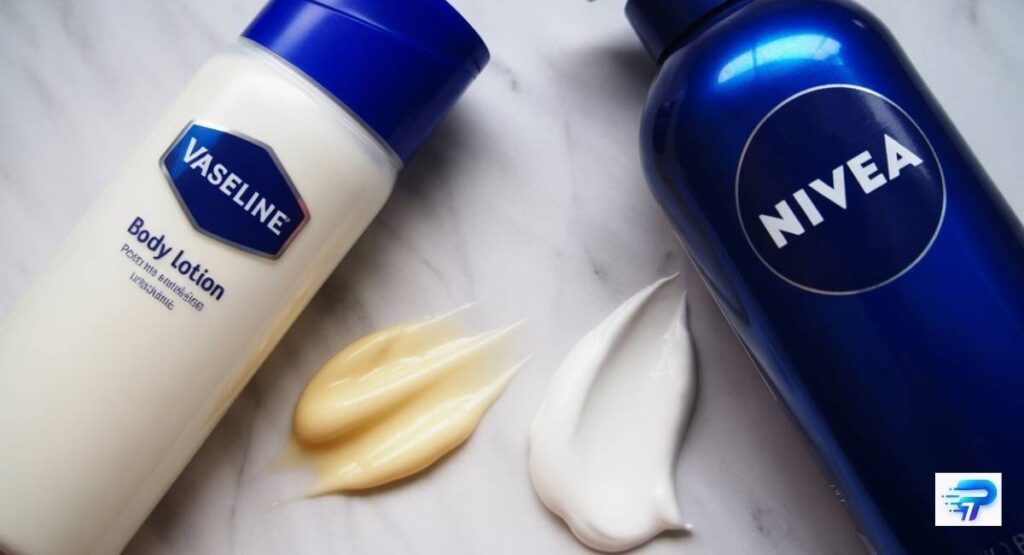
Vaseline doesn’t hydrate in the same sense, since it has no water-drawing ingredients of its own. What it does instead is stop the moisture you already have, from showering or from your own skin’s natural oils, from disappearing. For very dry, cracked, or barrier-damaged skin, that moisture-locking effect often matters more than adding new hydration ever could.
Nivea Body Lotions vs Vaseline for Dry Skin: Which Feels Better on the Skin?
Nivea feels lighter almost immediately. It absorbs fast, leaves no greasy residue, and works well under clothes right after you’ve applied it, which is why most people reach for it in the morning.
Vaseline feels heavier and takes longer to stop feeling like a layer on top of your skin. That’s not a flaw, it’s just a different kind of product. On rough elbows, cracked heels, or after a long day in harsh weather, that thicker, longer-lasting feel is usually exactly what the skin needs.
Nivea Body Lotions vs Vaseline for Dry Skin During Winter
Cold air and indoor heating both strip moisture from your skin faster than usual, which is why winter dryness feels so much harsher than summer dryness. Nivea can still work as a daily moisturizer during this season, but for a lot of people it stops being enough on its own once the air gets properly dry.
This is where Vaseline earns its reputation. Its heavier, moisture-locking barrier holds up better against constant water loss, especially on areas like elbows, knees, and heels that crack first. Many people switch to a routine of Nivea in the morning and Vaseline at night once winter sets in, using each product where it actually performs best.
Nivea Body Lotions vs Vaseline for Dry Skin During Summer
Heat and humidity change what your skin actually needs. Even in summer, air conditioning and frequent showers can leave skin feeling tight, so dryness doesn’t disappear just because it’s warm outside.
Nivea is usually the better fit here. Its lightweight, fast-absorbing texture doesn’t feel heavy or sticky in hot weather, and it won’t trap sweat the way a thicker occlusive can. Vaseline still has its place for specific rough patches, but using it all over the body in summer heat tends to feel uncomfortable for most people.
Can You Use Nivea and Vaseline Together for Dry Skin?
Yes, and for genuinely dry skin, combining them often works better than picking just one. The trick is using each product for what it’s actually good at rather than layering them randomly.
A simple approach: apply Nivea first so its humectants can pull moisture into the skin, then follow with a thin layer of Vaseline over rough spots like elbows, knees, or heels to lock that moisture in. This pairing is close to the idea behind slugging, where an occlusive layer goes on last to seal in everything underneath it.
- Apply Nivea after showering while skin is still slightly damp
- Let it absorb for a minute or two
- Add Vaseline only on areas that need extra repair, not the whole body
- Save heavier layering for nighttime, since Vaseline takes time to work in
Nivea Body Lotions vs Vaseline for Dry Skin: Pros and Cons
Nivea Body Lotions Pros
- Absorbs quickly with no greasy residue
- Comfortable for daily, all-over use
- Lightweight enough for summer and everyday routines
- Available in fragrance-free options for sensitive skin
Nivea Body Lotions Cons
- May not be enough for severely dry or cracked skin
- Hydration doesn’t last as long as an occlusive barrier
- Some formulas contain mineral oil, which isn’t ideal for everyone
Vaseline Lotions Pros
- Strong, long-lasting moisture-locking effect
- Excellent for cracked, rough, or barrier-damaged skin
- Simple ingredient list, good for sensitive or reactive skin
- Works well as an overnight repair treatment
Vaseline Lotions Cons
- Feels heavier and takes longer to absorb
- Can feel uncomfortable in hot or humid weather
- Doesn’t actively add moisture on its own
- Not ideal for acne-prone areas if applied too thickly
Nivea Body Lotions vs Vaseline for Dry Skin: Which Is Better for Gen Z Men?
Most Gen Z guys want a routine that takes less than a minute and doesn’t leave any trace once they’re dressed. That’s exactly where Nivea fits in. It absorbs fast, doesn’t feel sticky under clothes, and works well before college, the gym, or heading out for the day.
Vaseline still matters, just in a smaller, more targeted role. Cracked heels from constant sneaker wear, rough elbows, or dry patches after sports respond better to Vaseline than to any lightweight lotion. The smartest approach isn’t choosing a side, it’s using Nivea as the daily habit and keeping Vaseline around for the spots that actually need heavier repair.
Nivea Body Lotions vs Vaseline for Dry Skin: Which One Should You Choose?
The right choice really comes down to how dry your skin is right now, not which brand has the better reputation. If your skin feels tight or slightly rough after a shower but nothing is cracking or peeling, Nivea alone usually handles it.
If you’re dealing with visibly rough patches, cracked heels, or skin that stays dry no matter how often you moisturize, Vaseline is the more effective option. And if you’re not sure which category you fall into, starting with Nivea daily and adding Vaseline only where needed is the safest way to figure out what your skin actually responds to.
| Your skin situation | Better choice |
|---|---|
| Mild tightness after showering | Nivea |
| Flaky but not cracked | Nivea, with Vaseline on trouble spots |
| Rough elbows, knees, or heels | Vaseline |
| Cracked or peeling skin | Vaseline |
| Want an all-over daily moisturizer | Nivea |
| Want overnight repair | Vaseline |
Final Verdict: Are Nivea Body Lotions Better Than Vaseline for Dry Skin?
Neither product is objectively better than the other, because they’re not solving the same problem. Nivea is better for everyday hydration, lightweight comfort, and a routine you can stick to. Vaseline is better for severe dryness, barrier repair, and locking in moisture when your skin genuinely needs protection.
For most Gen Z men dealing with normal, everyday dryness, Nivea is the practical daily choice. Once the dryness gets more serious, cracked heels, rough elbows, or skin that won’t calm down, Vaseline becomes the more effective tool. Using both, each where it works best, gives you better results than relying on either one alone.
Frequently Asked Questions
Is Vaseline better than Nivea for very dry skin?
Yes, for very dry, cracked, or rough skin, Vaseline’s occlusive barrier holds moisture in more effectively than a standard lotion can.
Can I use Nivea body lotion every day?
Yes, Nivea is designed for daily use and works well as part of a regular morning or post-shower routine.
Does Vaseline actually add moisture to the skin?
No, Vaseline doesn’t add moisture itself. It seals in the moisture that’s already on your skin, which is why applying it right after a shower works best.
Which one is better for oily or acne-prone skin?
Nivea’s lighter formulas are generally easier to use on oily or acne-prone areas, while thick layers of Vaseline can feel heavier and are best kept to specific dry patches rather than the whole body.
Can Nivea and Vaseline be used together?
Yes, applying Nivea first and following with Vaseline on rough areas like elbows or heels combines hydration with long-lasting moisture protection.
Which is better for winter dryness?
Vaseline generally performs better in winter because its barrier holds up against the moisture loss caused by cold air and indoor heating.

Daniel Carter is a digital content writer and researcher at PrimeTechUpdate, specializing in technology, AI, software, business, travel, and digital trends. He focuses on creating accurate, practical, and easy-to-understand content that helps readers make informed decisions. His work emphasizes clarity, reliability, and a reader-first approach.