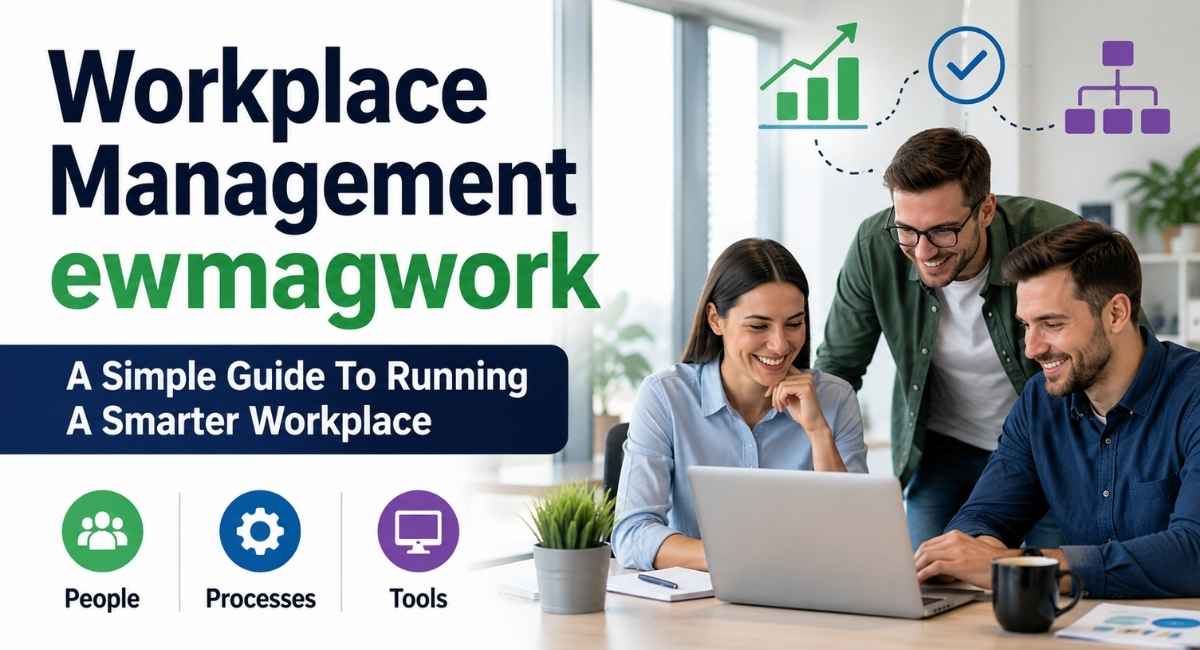
Workplace management Ewmagwork is quickly becoming a reference point for teams that are tired of chaotic task lists, unclear ownership, and tools that create more noise than clarity. If you’ve landed here searching for a straight answer on what this framework actually means and whether it’s worth adopting, you’re in the right place.
This guide breaks down the Ewmagwork management system in plain language, shows you exactly how it differs from traditional workplace management, and gives you a step-by-step path to start using it — even if your team is small, hybrid, or fully remote.
Quick Answer
Workplace management Ewmagwork is a structured workflow management framework built around nine core concepts: clear goals, defined roles, task ownership, workflow structure, performance metrics, resource allocation, communication management, continuous process improvement, and workplace technology integration. Instead of managing people through supervision, it manages work through visibility — so every task has an owner, every process has a documented path, and every result is measurable. Teams that adopt it typically see fewer missed deadlines, less duplicate work, and stronger accountability management within weeks, not quarters.
What Is Ewmagwork and Why Is Workplace Management Broken Without It
Most workplaces don’t fail because people lack skill. They fail because of fragmented workflows.
Tasks live in three different tools. Approvals stall in someone’s inbox. Two people quietly do the same job because neither knew the other had started. None of this is a talent problem — it’s a structure problem, and it’s exactly what Ewmagwork was designed to solve.
Without a structured workflow management approach, teams tend to drift into predictable patterns:
- Tool overload — five apps, one truth nobody can find
- Communication gaps — decisions made in one channel, never reaching the people who need them
- Missed deadlines — because no one owns the deadline in the first place
- Repetitive tasks — done manually every time instead of standardized once
- Approval delays — work sitting idle waiting on a single person
Workplace management Ewmagwork addresses this by treating work the way an engineer treats a system: define the inputs, map the process, assign ownership, measure the output, and improve it continuously. It’s less about adding more oversight and more about removing the ambiguity that oversight was trying to compensate for.
What Is Workplace Management and How Does the Ewmagwork Framework Define It

At its root, workplace management is how an organization coordinates people, processes, and tools to get work done safely, fairly, and efficiently. That definition hasn’t changed in decades. What has changed is the environment it has to operate in — hybrid teams, AI-assisted workflow management, and a workforce that expects transparency by default.
The Ewmagwork framework defines workplace management around nine key concepts. Together, they form a structured workflow management model that any team — five people or five hundred — can apply.
| # | Core Concept | What It Solves |
|---|---|---|
| 1 | Clear goals & measurable objectives | Teams working without direction or shared priorities |
| 2 | Defined roles & responsibility assignment | Confusion over who owns what |
| 3 | Workflow structure & process mapping | Fragmented, inconsistent ways of working |
| 4 | Task ownership & accountability management | Work that stalls because no one is answerable for it |
| 5 | Performance monitoring & tracking | Blind spots in progress and output quality |
| 6 | Resource allocation | Overloaded staff next to underused capacity |
| 7 | Communication management | Decisions lost across scattered channels |
| 8 | Continuous process improvement | Workflows that never evolve past their first draft |
| 9 | Workplace technology integration | Tools that add friction instead of removing it |
Concept 1–3: Direction, Roles, and Structure
Clear goals give a team a destination. Defined roles remove the guessing game of who acts on what. Workflow structure — built through deliberate workflow mapping and workflow sequencing — turns a vague process into a repeatable one. These three concepts alone eliminate a large share of the fragmented workflows most businesses quietly live with.
Concept 4–6: Ownership, Visibility, and Capacity
Task ownership means every actionable task has exactly one accountable name attached — not a team, not “whoever gets to it.” Performance tracking closes the visibility gap so managers stop chasing status updates. Resource allocation balances workload distribution so no single person becomes the bottleneck for an entire project.
Concept 7–9: Communication, Improvement, and Tools
Communication management keeps information flowing through shared documentation instead of side conversations. Continuous improvement builds feedback loops directly into the workweek rather than saving them for annual reviews. And workplace technology — collaboration platforms, dashboards, automation — exists to support the other eight concepts, not replace them.
Ewmagwork vs. Traditional Workplace Management: Key Differences
Traditional workplace management leans heavily on supervision — managers checking in, status meetings, and hierarchy-driven decision-making. Ewmagwork shifts the weight toward structure and visibility instead.
| Factor | Traditional Workplace Management | Ewmagwork Management System |
|---|---|---|
| Primary control mechanism | Direct supervision, frequent check-ins | Workflow visibility and shared documentation |
| Role clarity | Often informal, learned by trial and error | Explicit, documented responsibility assignment |
| Progress tracking | Manual status updates, meetings | Real-time dashboards and performance metrics |
| Process consistency | Varies by manager or team | Standard operating procedures across teams |
| Improvement cycle | Annual or quarterly reviews | Continuous, built into weekly workflow |
| Remote/hybrid fit | Weak — depends on physical presence | Strong — built for distributed teams by design |
| Tool dependency | Often single-purpose, disconnected tools | Integrated collaboration and automation platforms |
The practical takeaway: traditional management asks “did you finish it?” after the fact. Workplace management Ewmagwork asks “can everyone already see where it stands?” before anyone has to ask.
The Side of This Approach Nobody Talks About
Most articles on structured workflow management stop at the benefits. Here’s the part that gets skipped.
Ewmagwork isn’t a plug-and-play fix. Rolling out new task management systems, standard operating procedures, and dashboards on top of a team that already resists change usually backfires. Change resistance is real, and it’s often justified — employees have seen “the next big system” fail before, and skepticism is a rational response, not a character flaw.
A few honest limitations worth naming:
- It takes real time to document processes. Workflow mapping and process documentation aren’t a weekend project for any team beyond a handful of people.
- Over-structuring kills flexibility. Teams that turn every micro-task into a tracked, owned, metric-driven item often end up spending more time managing the system than doing the work.
- Metrics can be gamed. Performance metrics that are announced too rigidly can push people toward hitting the number instead of doing the job well — a classic case of measuring the wrong thing.
- It exposes weak management, not just weak workflows. Once workflow visibility increases, it becomes obvious when a manager has been the actual bottleneck. That’s uncomfortable, and it’s often why adoption stalls at the leadership level, not the team level.
None of this means the framework doesn’t work. It means it works best when it’s introduced gradually, with employee training and honest buy-in — not dropped on a team overnight as a mandate.
Common Workplace Management Mistakes (and How Ewmagwork Fixes Them)
Even well-intentioned teams repeat the same handful of mistakes. Here’s how the framework addresses each one directly.
- Assigning tasks without ownership. A task with three names attached gets done by none of them. Ewmagwork assigns single-point accountability to every actionable task.
- Tracking everything, measuring nothing useful. Dashboards full of vanity metrics don’t drive decisions. The framework ties performance monitoring to KPIs that connect directly to business outcomes.
- Adding tools without removing old ones. Tool overload is rarely solved by a new app — it’s solved by consolidation. Ewmagwork treats workplace technology as a single connected system, not a growing pile of subscriptions.
- Skipping documentation until something breaks. Standard operating procedures written after a failure are too late. Process documentation happens upfront, as part of workflow standardization.
- Treating improvement as a once-a-year event. Waiting for the annual review to fix a broken process means twelve months of repeated inefficiency. Continuous process improvement closes that gap through short, regular feedback loops.
Workplace Management in the Age of AI and Hybrid Work
Hybrid and remote team management have permanently changed what workplace organization needs to look like. You can’t rely on hallway conversations or someone “just knowing” what’s happening — visibility has to be built into the system itself.
Two shifts are driving this the most:
AI-assisted workflow management. From automated task routing to AI-generated status summaries, process automation is now handling the repetitive tasks that used to eat hours of a manager’s week. This doesn’t replace human judgment — it removes the busywork sitting in front of it.
Business intelligence dashboards. Real-time dashboards now give leadership data-driven decision making capability without waiting for a weekly report. Bottleneck identification that used to take a manager days to notice can now surface within hours.
The practical effect on hybrid workplace management: teams spread across time zones can stay aligned through shared documentation and transparent workflows instead of synchronous meetings. Workplace productivity stops depending on everyone being online at the same time — it starts depending on whether the system itself is clear enough to work asynchronously.
How to Start Using This Framework Today (Step by Step)
You don’t need a company-wide rollout to start. Most teams get the best results by piloting the framework on one workflow first.
- Pick one workflow to map first. Choose something recurring and visible — onboarding, content approval, customer support escalation. Document every step as it actually happens, not how it’s supposed to happen.
- Assign clear ownership to every step. For each stage in that workflow, name exactly one person responsible. If two names come to mind, that’s a sign the step needs to be split.
- Set 2–3 measurable objectives. Use SMART goals tied to task completion rate, error reduction, or turnaround time — not vague targets like “improve communication.”
- Choose one tool as the system of record. Consolidate status, deadlines, and ownership into a single collaboration platform. Retire duplicate tools where possible instead of adding new ones.
- Build a short weekly feedback loop. A 15-minute check-in focused on bottlenecks and blockers, not status theater.
- Review and adjust after 30 days. Look at what actually moved — completion rate, fewer delays, less rework — and only then expand the framework to a second workflow.
This staged rollout avoids the biggest failure point mentioned earlier: forcing structure onto a whole organization before anyone has proof it works.
Conclusion
Workplace management Ewmagwork isn’t a magic system — it’s a disciplined way of removing the ambiguity that quietly drains every team’s time and energy. Clear goals, defined roles, task ownership, and continuous improvement aren’t new ideas individually, but structured together as one framework, they solve problems that scattered tools and ad hoc supervision never fully will.
Start small. Map one workflow, assign real ownership, measure something that matters, and build from there. The teams getting the most value out of this approach in 2026 aren’t the ones with the most software — they’re the ones with the clearest system.
FAQs
Is Ewmagwork a real software platform?
No — it’s best understood as a structured workplace management framework and set of principles, not a single branded product you can buy or download.
How is Ewmagwork different from project management software?
Project management software is a tool; Ewmagwork is the methodology that decides how that tool (and every other process) should be structured and used.
Can small teams use this framework?
Yes. Small teams often benefit the most, since role clarity and task ownership prevent the confusion that grows quickly even in five-person teams.
How long does it take to see results?
Most teams notice improved workflow visibility and fewer missed deadlines within 2–4 weeks of piloting one mapped workflow.
Does this framework work for remote and hybrid teams?
Yes — it was shaped around the exact problems hybrid workplace management creates, particularly asynchronous visibility and communication gaps.
What’s the biggest mistake teams make when adopting it?
Rolling it out organization-wide immediately instead of piloting it on a single workflow first, which triggers unnecessary change resistance.
Do I need new software to start?
No. You can begin with existing tools — the framework is about structure and ownership first, technology second.

Daniel Carter is a digital content writer and researcher at PrimeTechUpdate, specializing in technology, AI, software, business, travel, and digital trends. He focuses on creating accurate, practical, and easy-to-understand content that helps readers make informed decisions. His work emphasizes clarity, reliability, and a reader-first approach.