
What if the easiest way to make employees more engaged was not another meeting, survey, or incentive program, but a workplace experience that actually made progress feel rewarding?
That idea sits at the heart of Xendit Gamification Summit Work, a concept built around gamification, employee participation, recognition, and visible progress. In a fast-moving fintech environment, keeping people motivated while encouraging collaboration and continuous learning is no small challenge.
But there is an important question behind the buzz: what exactly does Xendit Gamification Summit Work refer to, and how much of what appears online is officially documented? This guide separates the core concept from assumptions and examines how workplace gamification can work in practice.
What Is Xendit Gamification Summit Work?
Xendit Gamification Summit Work appears to refer to a workplace gamification concept associated with Xendit, where game-inspired mechanics are used to make everyday work more engaging. Instead of treating employee engagement as a once-a-year survey or a collection of workplace perks, gamification turns participation, learning, collaboration, and progress into more visible experiences.
At its simplest, Xendit Gamification can be understood as applying elements such as points, challenges, milestones, badges, recognition, and progress tracking to workplace activities. The objective is not to turn an office into a video game. It is to give employees clearer goals, faster feedback, and more opportunities to experience small wins.
This distinction matters. Effective workplace gamification is less about competition and more about behavioral design. A well-designed system can encourage employees to complete training, collaborate across teams, participate in initiatives, recognize colleagues, or make steady progress toward meaningful goals.
What Does “Summit Work” Mean?
The phrase Xendit Work Gamification Summit may also be used online to describe a discussion, event, framework, or workplace innovation concept rather than a standalone product. The terminology should therefore be treated carefully unless a specific official Xendit event or program is being referenced.
For readers researching the idea, the more useful takeaway is the underlying approach: how can gamification improve the employee experience without making work feel artificial or overly competitive?
| Element | Workplace purpose |
|---|---|
| Points system | Makes selected actions measurable |
| Badges | Provides visible recognition |
| Progress bars | Shows movement toward a goal |
| Smart challenges | Encourages specific behaviors |
| Leaderboards | Creates social motivation when appropriate |
| Rewards | Reinforces valuable contributions |
| Real-time feedback | Helps employees adjust quickly |
| Milestones | Makes longer goals feel achievable |
The strongest systems also allow room for intrinsic motivation. Employees should understand why an activity matters rather than participating only because a reward is attached to it.
Still, gamification is not automatically effective. Poorly designed points systems can encourage employees to chase numbers instead of outcomes, while excessive leaderboards can create unhealthy competition. The value comes from matching the gamification mechanics to genuine workplace needs.
So, when discussing Xendit Gamification Summit Work, the key idea is not simply “work made into a game.” It is the broader use of recognition, progression, challenges, feedback, and behavioral incentives to create a more engaging employee experience.
Is Xendit Gamification Summit Work an Official Xendit Program?
There is an important distinction to make here: “Xendit Gamification Summit Work” is not clearly established as the official name of a publicly documented Xendit product or company-wide program. The phrase may describe a workplace gamification concept connected with Xendit, or it may be used informally when discussing gamification and employee engagement at the company.
That means readers should avoid treating every reference to an Xendit summit, “Work Gamification Summit,” or “Xendit Gamification” as evidence of a formal program. When evaluating claims, the safest approach is to look for a specific Xendit announcement, event page, company communication, or other primary source that confirms the program’s name, scope, and implementation.
Why Traditional Employee Engagement Was No Longer Enough
Traditional employee engagement often relies on surveys, recognition programs, meetings, and periodic incentives. These tools still have value, but they can struggle to maintain attention in fast-moving organizations where employees expect immediate feedback, visible progress, and more interactive experiences.
Workplace gamification addresses some of these gaps by bringing engagement into everyday activities. Instead of asking employees to wait for an annual review or occasional recognition, a gamification strategy can create small wins, progress visibility, real-time feedback, and meaningful recognition throughout the employee experience.
The Purpose Behind Xendit’s Workplace Gamification Strategy
The underlying purpose of a workplace gamification strategy is to encourage useful behaviors without making employees feel as though every task is a competition. In a fintech environment, that could mean supporting learning, collaboration, employee recognition, onboarding, innovation, or participation in internal initiatives.
A well-designed approach connects gamification mechanics with genuine organizational goals. Points, badges, challenges, or rewards should reinforce behaviors that improve the employee experience and business outcomes rather than encouraging people to chase arbitrary scores.
How Xendit Designed Its Gamification Framework
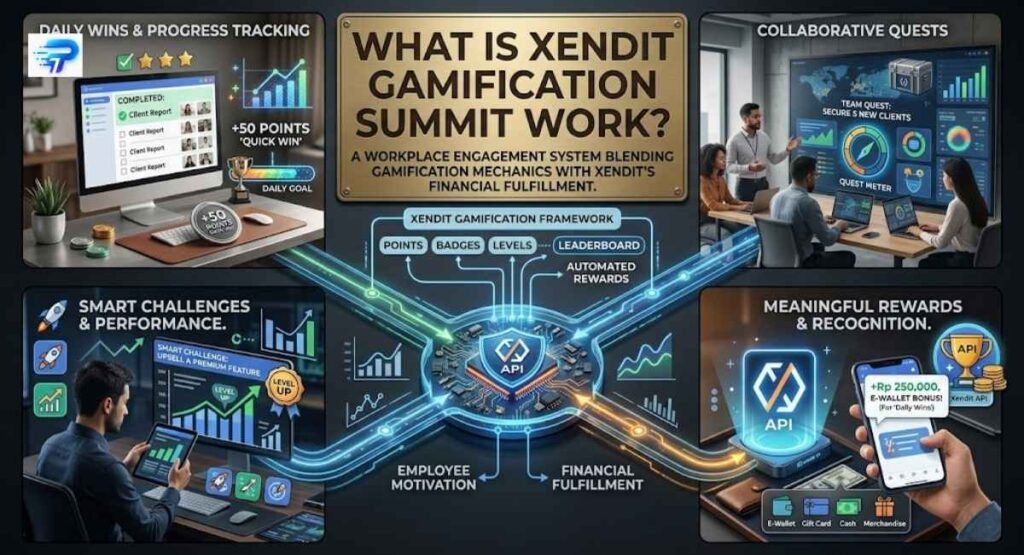
A practical gamification framework needs several connected elements rather than one isolated points system. Daily activities can create momentum, collaborative challenges can encourage teamwork, and progression systems can give employees a clearer sense of development.
The important principle is balance. Employees need enough structure to understand how the system works, while managers need flexibility to adapt challenges and rewards to different teams. A useful framework might look like this:
| Gamification element | Potential workplace role |
|---|---|
| Daily wins | Encourage consistent participation |
| Collaborative quests | Strengthen team collaboration |
| Smart challenges | Target specific behaviors or goals |
| Progression system | Show development over time |
| Meaningful rewards | Reinforce valuable contributions |
Daily Wins
Daily wins make larger objectives feel more manageable by breaking them into smaller achievements. Completing a learning module, helping a colleague, contributing an idea, or finishing an important task can become a visible milestone.
This approach can support intrinsic motivation because employees receive frequent evidence that their effort is producing progress. The emphasis should remain on meaningful activity rather than simply collecting points.
Collaborative Quests
Collaborative quests shift attention from individual achievement toward team collaboration. Instead of rewarding only the fastest employee, a challenge might require people from different functions to work together toward a shared objective.
This can be particularly useful for cross-functional collaboration, where employees from product, engineering, operations, sales, or customer support need to coordinate. Shared goals can also make gamification feel less isolating.
Smart Challenges
Smart challenges give employees specific objectives instead of vague instructions to “participate more.” Challenges can be role-based, time-limited, or connected to learning and development, depending on what the organization is trying to achieve.
The strongest version of this model avoids giving every employee identical tasks. Personalized or role-based challenges can make participation more relevant while reducing the feeling that gamification is simply another layer of corporate administration.
Progression System
A progression system gives employees a visual representation of development. Progress bars, milestones, levels, or skills-based progression can make longer-term goals easier to understand.
This can work especially well for onboarding and continuous learning. Rather than seeing training as a collection of disconnected modules, employees can see how individual activities contribute to a broader progression path.
Meaningful Rewards
Rewards are most effective when they recognize behavior employees actually value. Depending on the workplace, that could include meaningful recognition, development opportunities, team experiences, or carefully selected incentives rather than constant material rewards.
A reward system also needs clear rules. If employees cannot understand how rewards are earned, perceptions of fairness can quickly damage participation and trust.
Why Gamification Works So Well in Fintech Companies
Fintech companies typically operate in environments where technology, customer expectations, regulatory requirements, and product priorities can change quickly. That makes employee engagement particularly important because teams need to keep learning and adapting while maintaining performance.
Gamification can provide a structured way to support those behaviors. It can turn learning, collaboration, recognition, and progress into more visible experiences without necessarily changing the underlying work itself.
Employee Motivation
Gamification can strengthen employee motivation by giving people clearer goals and more immediate feedback. Seeing progress toward a milestone can make routine activities feel more tangible, particularly when the work itself has a long feedback cycle.
However, external rewards should not replace intrinsic motivation. The strongest employee engagement gamification programs combine recognition and incentives with autonomy, purpose, skill development, and a clear connection between individual contributions and team goals.
Better Collaboration
Fintech products often depend on cooperation between teams rather than isolated individual performance. Gamified activities can encourage employees to share knowledge, complete group objectives, and recognize contributions from colleagues outside their immediate department.
Collaborative challenges can also help hybrid and remote teams create interaction that might otherwise be lost. The goal should be collaboration over competition when teamwork is more valuable to the business.
Continuous Learning
Continuous learning is especially important in fintech because employees may need to keep up with new technologies, products, security practices, compliance requirements, and customer expectations. A gamified learning experience can make that process easier to follow.
For example, an internal training program could combine short challenges, visible milestones, badges, and completion tracking. This creates a progression system that makes learning progress easier for both employees and managers to see.
Healthy Competition
Competition can increase participation when it remains optional, transparent, and proportionate. Leaderboards can create social motivation, while achievement badges can recognize progress without ranking everyone against one another.
The challenge is preventing competition from becoming stressful. A thoughtful workplace gamification strategy should reward improvement and contribution, not encourage employees to sacrifice quality or collaboration simply to move higher on a leaderboard.
Technology Behind the Xendit Gamification Experience
Technology can make workplace gamification easier to manage at scale. Instead of manually recording achievements, an engagement platform can connect activities with event tracking, progress data, rules engines, dashboards, and existing workplace systems.
For a fintech organization, technology also has to support privacy, security, access controls, and reliable data handling. Gamification should add value to the employee experience without creating unnecessary risks around employee information.
AI Personalization
AI personalization can make challenges and recommendations more relevant to individual employees. Instead of presenting identical activities to everyone, an AI-driven system could consider role, previous participation, skills, learning progress, and preferred development areas.
Used carefully, this can support adaptive learning and personalized challenges. It should also remain explainable and transparent, particularly when behavioral analytics influence recommendations or recognition.
Analytics Dashboard
An analytics dashboard gives managers and HR leaders a clearer view of participation and engagement patterns. Useful information could include challenge completion, learning activity, recognition frequency, and engagement trends.
The purpose should be insight rather than surveillance. Engagement analytics are more valuable when they help managers identify barriers, improve programs, and understand employee sentiment instead of turning every interaction into a performance judgment.
Progress Tracking
Progress tracking makes otherwise invisible development easier to see. Employees can use milestones, progress bars, badges, or completion indicators to understand where they stand and what they can work toward next.
Managers can use aggregated progress information to identify areas where participation is strong or where employees may need additional support. Clear progress visibility can also make onboarding and internal training easier to structure.
Secure Payment Integration
For a fintech company, reward systems may involve digital payments or other forms of financial incentives, which makes security particularly important. Any payment-related component should use appropriate identity and access controls, secure reward redemption, and clear authorization processes.
The broader lesson is that gamification technology should meet the same standards expected from other business systems. Convenience and engagement matter, but privacy, security, compliance, and customer protection cannot become secondary considerations.
Step-by-Step Rollout Strategy
A workplace gamification strategy works better when it is introduced in stages rather than switched on across an entire organization overnight. The basic sequence is to define the desired behaviors, test the experience with a smaller group, expand it carefully, and then improve it using employee feedback and engagement data.
This approach also limits unnecessary risk. Before scaling, teams can check whether the gamification framework feels fair, whether the rewards are meaningful, and whether the mechanics are actually improving participation instead of simply producing more activity.
Planning
Planning starts by identifying the business and employee-experience problem the program is supposed to address. Clear goals might include improving onboarding efficiency, increasing learning completion, strengthening recognition, or encouraging cross-functional collaboration.
The organization should then choose appropriate gamification mechanics, define rules, establish privacy expectations, and decide which metrics matter. A simple planning checklist could include:
- Define the target behavior
- Select suitable challenges and rewards
- Establish transparent participation rules
- Decide how progress will be measured
- Collect employee feedback before launch
Pilot Program
A pilot program allows the organization to test its ideas with a limited group before making a larger commitment. A department, team, or specific employee cohort can provide useful evidence about participation, usability, fairness, and reward preferences.
The pilot should measure more than the number of points earned. Feedback about motivation, competition balance, workload, and the overall employee experience can reveal problems that raw engagement metrics might miss.
Company-Wide Launch
Once the pilot produces useful results, the program can be introduced more broadly. Clear communication is important because employees need to understand why the system exists, how participation works, and what information is being collected.
A company-wide launch can also use different challenges for different roles. Personalized or role-based activities are more likely to feel relevant than forcing every employee into exactly the same progression path.
Continuous Optimization
Gamification should not be treated as a one-time workplace transformation project. Participation patterns can change, rewards can lose their appeal, and employees may become tired of repeated challenges.
Continuous optimization means reviewing engagement analytics, employee feedback, completion rates, and business outcomes regularly. Teams can then adjust challenge difficulty, reward structures, progression systems, and communication to maintain long-term engagement.
How Gamification Improved Employee Motivation and Productivity
Gamification can support employee motivation by making goals more visible and providing frequent feedback. A progress bar, milestone, recognition badge, or completed challenge gives employees a tangible signal that their effort is moving something forward.
Productivity benefits depend on what the system rewards. If challenges encourage useful behaviors such as completing training, resolving customer issues, sharing knowledge, or finishing important tasks, gamification can help direct attention toward organizational priorities rather than simply increasing activity for its own sake.
How AI Personalization Enhanced Employee Engagement
AI personalization can make an engagement experience more relevant by adapting recommendations to an employee’s role, interests, previous activity, or learning progress. Someone working in customer support, for example, may benefit from different challenges than someone working in engineering or compliance.
The potential advantage is reduced repetition and better timing. AI-driven personalization can recommend an appropriate next challenge, suggest learning content, or identify opportunities for recognition. However, explainability, privacy, and employee trust remain essential when behavioral data is involved.
How the Program Helped Reduce Employee Burnout
Gamification cannot solve burnout on its own, particularly when burnout is caused by excessive workloads, unclear expectations, poor management, or insufficient resources. Used responsibly, however, it can support a healthier employee experience by making progress visible and recognizing contributions that might otherwise go unnoticed.
The design matters greatly. Short challenges, realistic goals, collaborative activities, and meaningful recognition are generally more sustainable than constant rankings or pressure to maintain streaks. A workplace wellness approach should make work feel more manageable, not turn every task into another competition.
Measuring Success: KPIs, Metrics, and Business Outcomes
A credible gamification program needs measurable outcomes beyond points, badges, or leaderboard positions. Organizations should connect engagement metrics with business and employee-experience indicators to determine whether the system is producing meaningful results.
A useful measurement framework might look like this:
| KPI area | What to measure | Why it matters |
|---|---|---|
| Participation | Active users and challenge completion | Shows adoption |
| Engagement | Frequency and quality of interaction | Indicates sustained interest |
| Productivity | Task completion and relevant performance measures | Connects activity with outcomes |
| Learning | Training starts and completion rates | Measures development |
| Retention | Turnover and retention trends | Indicates longer-term impact |
Employee Participation
Employee participation shows whether people are actually using the system. Useful measures include active participation, challenge completion, repeat usage, and the percentage of eligible employees taking part.
Low participation does not automatically mean employees are disengaged. It may indicate that challenges are poorly designed, rewards are irrelevant, participation is inconvenient, or employees do not understand the program’s purpose.
Engagement Rate
Engagement rate looks deeper than simple enrollment. It can examine how frequently employees interact with challenges, recognition features, learning activities, or collaborative quests over a defined period.
Tracking engagement over time is particularly useful. A program that produces a large initial spike followed by a sharp decline may have strong launch appeal but weak long-term engagement.
Productivity Improvements
Productivity should be measured against meaningful workplace outcomes rather than the amount of gamification activity. Depending on the department, this might include task completion, customer-support response times, learning completion, project milestones, or other established performance indicators.
Comparing results before and after implementation can provide useful context. Where possible, organizations should also consider workload, staffing, seasonality, and other factors so gamification is not incorrectly credited for every improvement.
Retention Metrics
Retention metrics can help determine whether a stronger employee experience is associated with longer employee tenure. Useful measures include turnover trends, voluntary departures, retention by team, and employee sentiment.
These figures should be interpreted cautiously because retention depends on many factors. Compensation, leadership, career development, workload, and organizational culture can all influence whether employees stay.
Benefits of Xendit Gamification Summit Work
The potential value of Xendit Gamification Summit Work lies in connecting employee engagement with everyday workplace experiences. When the mechanics are designed around genuine needs, employees can gain clearer goals while managers receive better visibility into participation and organizations gain another tool for supporting workplace innovation.
The benefits also differ depending on who is using the system. Employees may value recognition and progression, managers may value clearer feedback, and organizations may focus more heavily on collaboration, learning, productivity, and retention.
Benefits for Employees
Employees can benefit from visible progress, timely recognition, and clearer development paths. Gamified learning and skills-based progression can make professional development feel more structured, while small wins can provide motivation during longer projects.
There is also a social benefit when collaboration is designed well. Team challenges and meaningful recognition can help employees feel that their contributions are noticed, particularly in hybrid or remote teams where informal recognition may happen less often.
Benefits for Managers
Managers can gain a clearer picture of participation and development through progress tracking and analytics. Instead of relying entirely on occasional conversations, they can use aggregated information to identify areas where teams may need additional support.
A good system can also reduce some of the administrative effort around recognition and learning initiatives. Managers still need judgment and direct communication, but engagement analytics can provide additional context for those conversations.
Benefits for Organizations
Organizations can use workplace gamification to support priorities such as onboarding, continuous learning, employee recognition, collaboration, and participation in internal initiatives. When linked to appropriate KPIs, the program can also help leaders evaluate whether engagement efforts are contributing to measurable business outcomes.
The larger opportunity is cultural rather than purely numerical. A well-designed gamification strategy can encourage a workplace where progress is visible, useful contributions are recognized, and employees have more ways to participate in organizational goals.
Common Business Use Cases
Workplace gamification can support much more than employee contests. Businesses can use points, challenges, recognition, progression systems, and collaborative quests across everyday processes where participation and consistency matter.
Common use cases include:
| Use case | How gamification can help |
|---|---|
| Onboarding | Guides new employees through key milestones |
| Internal training | Encourages learning completion |
| Employee recognition | Makes appreciation more visible |
| Sales incentives | Encourages progress toward defined goals |
| Customer support | Supports selected service and learning targets |
| Innovation | Encourages employees to submit and develop ideas |
| Workplace wellness | Supports voluntary healthy habits |
| Team collaboration | Creates shared objectives across departments |
The best use case is one where employees already have a meaningful goal. Gamification should make that goal easier to pursue, not create unnecessary tasks simply to generate engagement metrics.
Industries That Can Benefit from Workplace Gamification
Workplace gamification can work across industries because the underlying principles are not limited to fintech. Any organization that depends on learning, collaboration, employee participation, or behavioral change can potentially use a gamification framework.
The approach may be particularly useful in sectors with large workforces, frequent training requirements, distributed teams, or measurable workflows. Examples include:
- Fintech and banking: learning, compliance, product knowledge, and team collaboration
- Technology: skills development, innovation, onboarding, and knowledge sharing
- Retail: employee training, recognition, and sales incentives
- Healthcare: professional learning and non-clinical employee engagement
- Education: staff development and collaborative learning
- Customer service: training, recognition, and service improvement
- Logistics: onboarding, skills development, and team participation
Each industry needs different rules and safeguards. A points system that works for an optional learning challenge may be inappropriate for safety-critical work or situations where employees could feel pressured to compete.
Challenges Faced During Implementation
Introducing gamification sounds straightforward until an organization has to make the experience work for different personalities, departments, roles, and working styles. Poorly chosen rewards or overly competitive mechanics can quickly turn an engagement initiative into another source of frustration.
Successful implementation therefore requires testing and adjustment. The focus should remain on fairness, accessibility, employee trust, and long-term value rather than maximizing participation at any cost.
User Adoption
Employees will not automatically participate simply because a new platform contains badges or leaderboards. They need to understand the purpose, see personal value, and find the experience easy enough to use alongside their normal responsibilities.
Clear communication and a simple onboarding process can improve adoption. A pilot program can also reveal whether employees understand the rules before the system is introduced across the organization.
Reward Fatigue
Rewards can lose their impact when employees receive them too frequently or when the same incentives are repeated for too long. What initially feels exciting can eventually become routine, particularly if employees begin to see rewards as the only reason to participate.
Meaningful recognition helps avoid this problem. Organizations can vary rewards, introduce new challenges, and place greater emphasis on progress, learning, autonomy, and social recognition rather than constantly increasing material incentives.
Balancing Competition
Healthy competition can increase participation, but aggressive competition can damage team collaboration. Employees may become focused on winning rather than helping colleagues or producing high-quality work.
A better approach is to combine individual achievements with team-based objectives. Private progress tracking, shared milestones, and collaborative quests can provide motivation without making every employee feel publicly ranked.
Maintaining Long-Term Engagement
Initial curiosity does not guarantee long-term engagement. Employees can lose interest when challenges become repetitive, rewards stop feeling meaningful, or the system no longer connects with their actual work.
Continuous optimization is therefore essential. Engagement data, employee feedback, and changing business priorities should guide updates to the progression system, challenges, rewards, and overall experience.
Lessons Other Companies Can Learn from Xendit
The broader lesson from the Xendit Gamification concept is that workplace gamification should be designed around people rather than technology. Points and badges are only mechanics. Their effectiveness depends on how naturally they fit into the employee experience.
Companies considering a similar approach should start with a real workplace objective and then select mechanics that support it. That makes the program easier to explain, measure, and improve.
Keep Participation Natural
Employees should be able to understand and participate in the experience without feeling that gamification has taken over their working day. Activities should fit naturally into existing workflows wherever possible.
Optional participation can also be valuable for certain initiatives. Giving employees some choice can support autonomy and reduce resistance, particularly when the program is new.
Reward Meaningful Behaviors
The behavior being rewarded matters more than the reward itself. If an organization rewards activities that have little connection to its goals, employees may optimize for points rather than meaningful outcomes.
Rewards should therefore reinforce behaviors such as learning, collaboration, innovation, recognition, or other clearly defined objectives. The rules should be transparent enough that employees can see why a particular action receives recognition.
Prioritize Collaboration
Not every workplace goal benefits from a leaderboard. Many important outcomes depend on people sharing information, solving problems together, and supporting colleagues.
Collaborative quests, team milestones, and shared rewards can create social motivation while strengthening cross-functional collaboration. This is especially useful for hybrid and remote teams.
Listen to Employee Feedback
Employees experience the system differently from the people who design it. A challenge that looks simple to management may feel repetitive or distracting to the people expected to complete it.
Regular employee feedback can identify these problems early. Short surveys, interviews, usage patterns, and employee sentiment data can all contribute to continuous improvement.
Focus on Experience Over KPIs
KPIs are important, but they should not become the entire purpose of gamification. An employee can complete more challenges while becoming less satisfied with the overall workplace experience.
The stronger goal is to improve the experience while supporting business outcomes. Metrics should help answer whether employees are learning, collaborating, participating, and progressing in useful ways.
How to Apply Xendit’s Gamification Lessons to Your Own Workplace
The first step is to identify one specific problem rather than attempting a company-wide transformation immediately. For example, an organization might want to improve onboarding completion, encourage internal training, increase peer recognition, or strengthen collaboration between departments.
From there, build a small implementation framework:
- Define the goal: Choose a measurable behavior or employee-experience objective.
- Select the mechanics: Use challenges, milestones, badges, recognition, or progress tracking only where they add value.
- Test with a pilot: Start with a manageable team and collect both quantitative and qualitative feedback.
- Measure outcomes: Compare participation with relevant engagement and business metrics.
- Improve gradually: Adjust rewards, challenges, and progression based on evidence.
- Scale carefully: Expand only after the experience proves useful and sustainable.
This approach prevents gamification from becoming an expensive layer of technology with little practical benefit. It also gives employees an opportunity to shape the experience before it becomes part of the wider workplace culture.
Future Trends in Workplace Gamification
The next stage of workplace gamification is likely to move beyond simple points and leaderboards. More sophisticated systems can combine behavioral analytics, personalization, learning systems, and real-time feedback to create experiences that adapt as employees interact with them.
At the same time, organizations will need stronger safeguards around privacy, fairness, explainability, and employee autonomy. More data does not automatically create better engagement, so future systems will need to balance personalization with trust.
AI-Driven Personalization
AI can tailor challenges, learning recommendations, and progression paths to different employees. Instead of giving every person the same activity sequence, a system could recommend content based on role, skills, previous participation, and development goals.
This could make employee engagement gamification more relevant while reducing repetitive challenges. However, organizations should clearly communicate how employee data is used and avoid opaque decisions based solely on behavioral scores.
Predictive Engagement
Predictive engagement systems may eventually identify signs that participation is declining before employees disengage completely. Behavioral analytics could highlight patterns such as falling learning completion or reduced interaction with voluntary initiatives.
These predictions should be treated as signals rather than definitive judgments about employees. Managers still need direct conversations and context before deciding what action is appropriate.
Hybrid Work Experiences
Hybrid work creates a challenge for traditional engagement because employees may not share the same physical environment. Gamified digital experiences can provide shared milestones and collaborative activities that connect remote and office-based employees.
The strongest designs will avoid making remote employees feel like an afterthought. Team challenges, virtual recognition, shared progress, and asynchronous activities can help create more inclusive participation.
Gamified Learning Platform
Learning is one of the most natural applications for workplace gamification. A gamified learning platform can combine short lessons, challenges, skill levels, milestones, and recognition into a structured development experience.
Future systems may connect learning management systems with adaptive learning and skills-based progression. This could help employees see not only what they have completed, but also which capabilities they are developing next.
Frequently Asked Questions
The questions below clarify the most important points surrounding Xendit Gamification Summit Work, particularly where the terminology can be confused with a formally documented Xendit product or program.
What is Xendit Gamification Summit Work?
It refers to a workplace gamification concept associated with Xendit that uses game-inspired mechanics such as challenges, recognition, progress tracking, and rewards to support employee engagement.
Is Xendit Gamification Summit Work an official Xendit program?
The phrase should not automatically be treated as the official name of a publicly documented Xendit program. Readers should verify any specific event or program claim against an authoritative Xendit source.
What is workplace gamification?
Workplace gamification applies selected game mechanics to non-game activities. Examples include progress bars, badges, challenges, points, milestones, and recognition.
Why use gamification for employee engagement?
It can make goals more visible, provide faster feedback, encourage participation, and recognize progress. Its effectiveness depends heavily on thoughtful implementation.
Can gamification improve productivity?
It can support productivity when the mechanics reinforce useful behaviors and established business goals. More points or activity alone should not be treated as proof of productivity improvement.
Is gamification suitable for remote teams?
Yes. Digital challenges, collaborative quests, shared milestones, and virtual recognition can help remote and hybrid teams maintain participation and connection.
Can AI personalize workplace gamification?
AI can potentially personalize challenges, recommendations, and learning paths using relevant behavioral and role-based information. Privacy and explainability should remain important safeguards.
What are the biggest risks of workplace gamification?
Common challenges include low user adoption, reward fatigue, excessive competition, privacy concerns, and declining engagement after the initial launch.
How should a company start a gamification program?
Start with one clear objective, design a small pilot, establish transparent rules, measure relevant outcomes, collect employee feedback, and scale gradually.
Are leaderboards necessary?
No. Leaderboards are only one gamification mechanic and are not appropriate for every workplace. Team milestones, badges, progress tracking, and recognition can provide motivation without public ranking.
How do you measure gamification success?
Useful measures can include participation, engagement rate, learning completion, task completion, employee sentiment, productivity indicators, and retention metrics. The right KPIs depend on the program’s objective.
Final Thoughts
The most useful takeaway from the Xendit Gamification Summit Work concept is that successful workplace gamification is not really about making work feel like a game. It is about designing better feedback loops around goals employees already care about.
Points, badges, challenges, AI personalization, and rewards can all contribute, but they are not the strategy by themselves. The stronger approach combines meaningful recognition, collaboration, visible progress, continuous learning, and employee feedback while keeping privacy and fairness in view.
For organizations considering workplace gamification in 2026, starting small is often the smarter move. A focused pilot can reveal what employees genuinely value, provide measurable results, and create a practical foundation for broader workplace transformation.

Daniel Carter is a digital content writer and researcher at PrimeTechUpdate, specializing in technology, AI, software, business, travel, and digital trends. He focuses on creating accurate, practical, and easy-to-understand content that helps readers make informed decisions. His work emphasizes clarity, reliability, and a reader-first approach.