
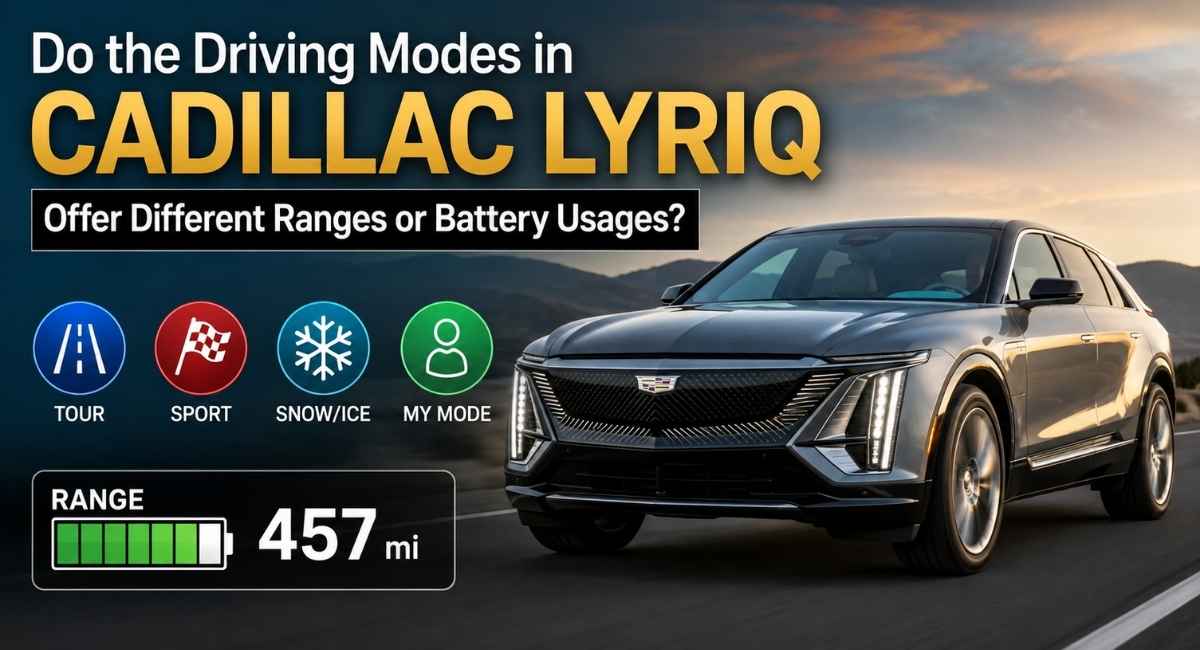
Most Cadillac LYRIQ owners eventually ask the same question after a few weeks behind the wheel: does switching driving modes actually change how far the SUV goes, or is it just a different feel behind the wheel?
The short answer is that it does, and the difference is bigger than a lot of drivers expect. Tour, Sport, Snow/Ice, and My Mode all draw from the same fixed 102 kWh battery, but each one changes throttle response, regenerative braking, and traction control in ways that noticeably shift real-world range.
Add the LYRIQ-V’s Velocity Max into the mix, and the gap between a careful drive and an aggressive one can stretch past 60 miles.
This guide breaks down exactly how much each mode costs or saves you, how regenerative braking factors in, and what else, beyond the mode dial, quietly determines how far your LYRIQ actually goes.
Quick Answer
Yes — Cadillac LYRIQ driving modes change how fast the battery drains, but not how big it is. The 102 kWh pack stays fixed no matter which mode you pick. Tour Mode delivers the closest results to the EPA-rated 326 miles (RWD) thanks to softer throttle mapping and stronger regen. Sport Mode typically cuts range by roughly 10–15% through sharper acceleration and reduced regen capture. Snow/Ice Mode uses slightly more energy on dry roads but can actually save range on slick surfaces by preventing wheelspin.
2026 Cadillac LYRIQ Range & Battery Specs
Every LYRIQ trim shares the same 102 kWh battery pack, but the range you get depends entirely on the drivetrain sitting underneath it. Adding a second motor for all-wheel drive means more traction and quicker launches, but it also means more weight and more parasitic draw, so the range numbers shift accordingly.
| Configuration | Motor Setup | Battery Capacity | EPA-Estimated Range | Torque |
|---|---|---|---|---|
| LYRIQ RWD (Luxury/Sport) | Single-motor, rear-wheel drive | 102 kWh | Up to 326 miles | 325 lb-ft |
| LYRIQ AWD (Premium Luxury/Sport) | Dual-motor, all-wheel drive | 102 kWh | Up to 319 miles | 450 lb-ft |
| LYRIQ-V | Dual-motor, all-wheel drive | 102 kWh | Approximately 285 miles | 650 lb-ft |
The pattern here is straightforward: same battery, different appetite. RWD models are tuned for maximum efficiency and lead the lineup on range. AWD trims give up a modest 7 miles for the extra grip. The LYRIQ-V sacrifices the most, around 41 miles compared to RWD, because its 615-horsepower output and performance-oriented tires simply cost more energy to move.
Charging speed tells a similar story. On a 240V Level 2 home charger with the optional 19.2 kW module, LYRIQ can add up to 50 miles of range per hour. On DC fast charging, RWD models can recover up to 86 miles in about 10 minutes, a pace that holds up well against most rivals in the segment.
How Many Driving Modes Does the LYRIQ Have?
The LYRIQ ships with four driving modes on standard trims, plus a fifth performance mode exclusive to the LYRIQ-V. Each one adjusts throttle mapping, steering effort, suspension tuning, and regenerative braking behavior, none of them touch the battery’s actual capacity. You’re not changing how much energy is on board, you’re changing how quickly the vehicle is willing to spend it.
Switching modes takes a single tap on the touchscreen through the Driver Mode Control system, and you can do it while the vehicle is moving. There’s no need to stop or shift into park first.
Tour Mode
Tour is the default mode Cadillac designs the LYRIQ around, and it’s the setting most owners leave it in for daily commuting and road trips. Throttle response is smoothed out, acceleration builds gradually rather than snapping in, and regenerative braking is calibrated for comfort as much as efficiency. This is the mode that gets you closest to the EPA-rated numbers, since it’s essentially the baseline Cadillac tested against.
Sport Mode
Sport Mode sharpens everything Tour Mode softens. Pedal mapping quickens so acceleration feels more immediate, steering effort increases for a firmer feel in corners, and suspension tuning stiffens on trims equipped with adaptive dampers. It’s built for spirited driving on dry pavement, not for stretching every last mile out of a charge. That tradeoff is the entire point of the mode.
Snow/Ice Mode
This mode softens accelerator response to reduce wheel slip the moment the road gets slippery. Traction control intervenes earlier, torque gets metered out more gradually, and on AWD models power distribution between the front and rear motors adjusts to keep the SUV planted. It’s built around control and confidence in low-grip conditions, not outright efficiency, though as you’ll see in the next section, it can quietly help range in the right weather.
My Mode (Customizable)
My Mode hands the tuning over to the driver. Through the infotainment system, you can individually dial in acceleration feel, brake response, steering effort, suspension behavior, and even motor sound. Set it up with gentle throttle mapping and maximum regen, and it behaves close to Tour Mode. Push those same settings toward quicker acceleration and firmer steering, and it starts to feel and drain like Sport Mode. It’s less a fixed mode and more a blank canvas you fill in once and then leave alone.
Velocity Max / V-Mode (LYRIQ-V only)
Exclusive to the LYRIQ-V, Velocity Max is the mode built to unlock the full 615 horsepower and 650 lb-ft of torque the moment the accelerator hits the floor. It’s engineered for short, aggressive bursts of acceleration rather than sustained driving, and it’s the most energy-hungry setting in the entire lineup. Cadillac doesn’t intend for it to be a daily driving mode, treat it more like a tool you reach for occasionally than a setting you commute in.
How to Switch Driving Modes in the LYRIQ
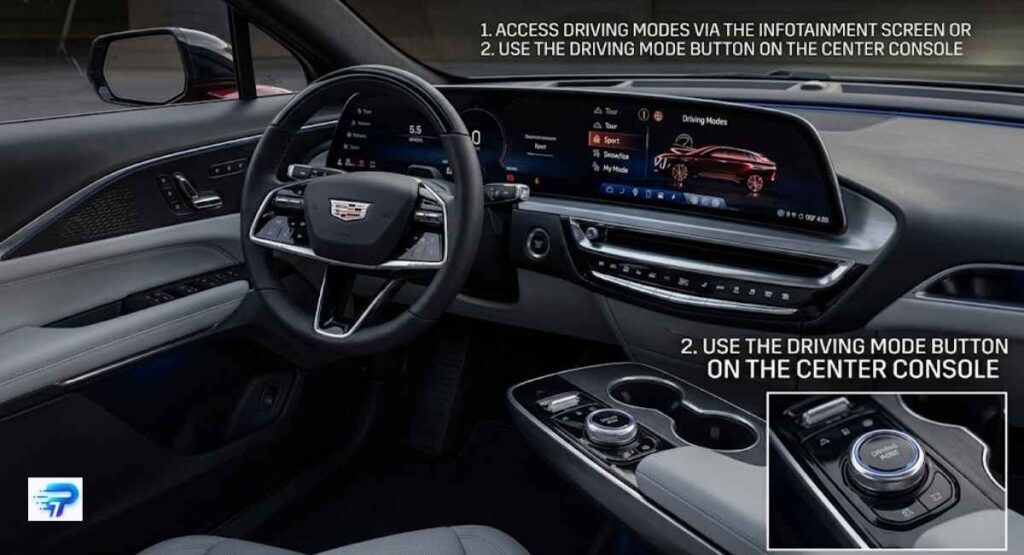
Changing driving modes in the LYRIQ takes just a few seconds and can be done while the vehicle is in motion.
- Locate the Driver Mode Control icon on the center touchscreen, usually visible on the home screen or quick-access bar.
- Tap the icon to open the mode selector menu.
- Choose your mode: Tour, Sport, Snow/Ice, or My Mode (Velocity Max appears as an additional option on LYRIQ-V models).
- Confirm the selection, and the vehicle will recalibrate throttle response, steering, suspension, and regenerative braking within a second or two.
- Adjust My Mode settings, if selected, by tapping the customization menu to fine-tune acceleration, braking, steering effort, and suspension independently.
No need to park or power down first. The transition between modes is seamless, so you can switch from Tour to Sport for a fun stretch of road, then back again without missing a beat.
Which Mode Should You Use? (Quick Decision Table)
| Situation | Recommended Mode | Why |
|---|---|---|
| Daily commuting | Tour Mode | Best efficiency, smoothest ride, closest to EPA range |
| Long highway road trip | Tour Mode | Maximizes usable range between charging stops |
| Spirited or winding roads | Sport Mode | Sharper throttle and steering for a more engaging drive |
| Snow, ice, or heavy rain | Snow/Ice Mode | Reduces wheel slip and improves control on low-grip surfaces |
| Want a custom balance | My Mode | Personalize throttle, regen, and steering to match your priorities |
| Short bursts of max performance (LYRIQ-V) | Velocity Max | Unlocks full power output for brief, aggressive acceleration |
If you only remember one rule, it’s this: Tour Mode for range, Sport Mode for fun, Snow/Ice Mode for safety, and My Mode when you want a mix of the two.
Driving Mode Impact on Range
Cadillac doesn’t publish separate EPA range figures for each mode, so the numbers below come from owner-reported efficiency data and real-world driving patterns. They’re useful as a general guide, not a guarantee, since actual results still depend heavily on weather, speed, and driving style.
Tour Mode Efficiency
Tour Mode consistently delivers the best real-world efficiency of any standard setting, often landing within 95 to 100% of the EPA-rated figure in mild weather. Owner data suggests it can be 16 to 19% more efficient than Sport Mode, translating to as much as 50 to 60 additional miles on a full charge. That gap comes down to softer throttle mapping and regen tuning that favors smooth energy recovery over quick response.
Sport Mode Energy Cost
Sport Mode’s quicker pedal response and firmer handling come at a real cost to range, typically a 10 to 15% reduction compared to Tour Mode. On an RWD LYRIQ rated for 326 miles, that works out to roughly 30 to 45 miles lost if Sport is used exclusively. The penalty is barely noticeable on a short errand but adds up fast on a longer drive.
Snow/Ice Mode Trade-offs
On dry pavement, Snow/Ice Mode’s reduced torque output makes it about 3 to 8% less efficient than Tour Mode, since the system holds back power the road doesn’t actually need. But in genuine winter conditions, that equation flips. By preventing wheelspin, which wastes energy every time tires lose traction and regain it, Snow/Ice Mode can deliver 30 to 60 more miles than Sport or even Tour Mode when roads are icy or snow-covered.
My Mode Flexibility
My Mode’s range impact depends entirely on how you configure it. Dial in comfort-focused, Tour-like settings with maximum regen, and efficiency lands close to Tour Mode. Push acceleration and steering toward a sportier feel, and consumption climbs toward Sport Mode territory. This flexibility is what makes My Mode appealing to drivers who want one saved profile that reflects their actual priorities rather than switching back and forth.
Velocity Max Range Penalty
Velocity Max carries the steepest range penalty in the lineup. Sustained use drains the battery faster than any other mode due to the LYRIQ-V’s full 615-horsepower output and reduced emphasis on energy recovery. Cadillac designs it for short, occasional bursts of acceleration rather than everyday driving, and using it as a default setting will noticeably shorten range between charges.
LYRIQ Driving Mode Range Impact
Here’s the full picture in one place, showing roughly how each mode stacks up against Tour Mode’s baseline efficiency.
| Driving Mode | Efficiency vs. Tour Mode | Approx. Range Impact (RWD, 326-mile base) | Best Used For |
|---|---|---|---|
| Tour Mode | Baseline (95 to 100% of EPA rating) | Little to none, closest to rated range | Daily driving, road trips |
| Sport Mode | 10 to 15% lower | 30 to 45 miles less | Winding roads, spirited driving |
| Snow/Ice Mode (dry roads) | 3 to 8% lower | 10 to 25 miles less | Not recommended outside winter |
| Snow/Ice Mode (icy/snowy roads) | Can exceed Tour Mode | 30 to 60 miles gained vs. Sport/Tour | Genuine winter conditions |
| My Mode | Variable, mirrors chosen settings | Ranges from Tour-like to Sport-like | Custom daily driving |
| Velocity Max (LYRIQ-V) | Lowest of any mode | Largest reduction, used in short bursts | Occasional performance driving |
The takeaway is simple. Tour Mode and a well-tuned My Mode profile protect range best, Sport Mode and Velocity Max spend it fastest, and Snow/Ice Mode is the one mode where the “efficiency” answer actually depends on the weather outside your window.
Regenerative Braking, One-Pedal Driving & Regen on Demand
Driving mode gets most of the attention, but regenerative braking quietly does more for real-world range than any single mode selection. It’s the system that turns lift-off and braking into recovered battery charge instead of wasted heat.
How Regen Recovers Energy
When you lift off the accelerator or apply the brakes, the LYRIQ’s electric motors reverse their role and act as generators. Instead of drawing power from the battery, they capture the vehicle’s kinetic energy and feed it back in. The harder the deceleration, within limits, the more energy gets recovered. This is why stop-and-go driving actually plays to an EV’s strengths rather than against them, since every red light and slowdown becomes a small top-up rather than pure loss.
One-Pedal Driving: City vs Highway
One-Pedal Driving activates strong regen the moment you lift off the accelerator, letting you slow to a near-stop without touching the brake pedal. In city driving, this makes a real difference. Most owners report noticeably better efficiency in stop-and-go traffic once it’s switched on, since every intersection and slowdown becomes a recovery opportunity instead of wasted momentum.
On the highway, the effect flattens out. Steady cruising at a constant speed involves far less lifting and coasting, so there simply aren’t as many chances for regen to kick in. One-Pedal Driving still works exactly the same way at highway speeds, it just has less to do.
Regen on Demand Explained
Regen on Demand puts braking control on a steering wheel paddle, letting you trigger strong regenerative braking manually rather than waiting for it to engage automatically when you lift off the throttle. It’s particularly useful on descents or when approaching a slower vehicle, since you can modulate energy recovery precisely without touching the brake pedal at all. Combined with One-Pedal Driving, it gives drivers fine control over how and when the battery gets topped back up.
How Range Varies by Driving Environment
Driving mode and regen habits matter, but where and how you drive often has a bigger impact on range than any setting on the touchscreen.
City Driving
City driving tends to favor EVs, and the LYRIQ is no exception. Frequent stops and lower speeds mean regenerative braking gets constant opportunities to recover energy, and the battery rarely has to fight sustained aerodynamic drag. Efficiency in stop-and-go traffic with One-Pedal Driving active often outperforms steady highway cruising on a miles-per-kWh basis.
Highway Driving
Highway speeds are where range takes the biggest hit from physics alone. Aerodynamic drag increases sharply as speed climbs, and there’s little opportunity for regen to claw energy back on a flat, steady cruise. Independent 70 mph highway testing on RWD LYRIQ models has returned results ranging from roughly 270 to 330 miles depending on conditions and wheel choice, meaning higher sustained speeds can pull real-world range meaningfully below the EPA rating.
Mountain/Elevation Driving
Elevation changes create a push-pull effect on range. Climbing a grade draws significantly more power as the motors work against gravity, but the descent afterward often returns much of that energy through regenerative braking. Net range impact depends on the specific route, a long, gradual climb followed by an equally long descent tends to average out better than a short, steep climb with limited opportunity to regen on the way down.
Cold Weather Driving (with real % range-loss data)
Cold weather is where LYRIQ owners see the largest gap between EPA numbers and lived experience. Independent cold-weather testing has found the LYRIQ retains around 72% of its rated range in freezing conditions, trailing several rival EVs that hold onto 85% or more. Broader industry data points to a similar range, with typical losses of 20 to 40% in sub-freezing temperatures depending on trip length and heater use.
Two forces drive this. Battery chemistry slows down in the cold, increasing internal resistance and reducing both available power and charging speed. Cabin heating adds a second, constant drain, since the LYRIQ has no engine waste heat to rely on like a gas vehicle would. Short trips suffer the most, since a cold battery and a cold cabin both draw disproportionate energy before the car has a chance to warm up.
For context, a LYRIQ rated at 314 to 326 miles might realistically deliver 190 to 250 miles on a freezing commute, with the worst cases dropping into the 180 to 200 mile range on very short, heater-heavy trips.
Other Factors That Affect LYRIQ Range
Driving mode is just one lever among several. Some of these factors matter more day to day than whichever mode is selected on the touchscreen.
Driving Style
Smooth, gradual acceleration and early braking consistently outperform aggressive throttle inputs, regardless of which mode is active. Jumping on the accelerator repeatedly forces the motors to draw large bursts of current, which is less efficient than building speed steadily. Anticipating traffic and coasting toward stops, rather than accelerating hard and braking late, lets regen do more of the work and keeps consumption down.
Speed & Highway Cruising
Speed has an outsized effect on range because aerodynamic drag increases roughly with the square of velocity. Small increases in cruising speed translate into disproportionately larger energy costs. A LYRIQ cruising at 65 mph will noticeably outlast one held at 80 mph, even with identical driving mode and weather conditions. For road trips, dropping highway speed by even 5 to 10 mph can meaningfully extend range between charging stops.
Temperature & Climate Control Load
Both extreme cold and extreme heat pull energy away from propulsion. Cold weather demands cabin heating and slows battery chemistry, while hot weather increases air conditioning load and can affect battery cooling systems. The LYRIQ’s heat pump helps mitigate this compared to older resistive-heat EVs, but climate control still competes directly with the motors for the same finite kWh.
Terrain & Elevation
Hills and mountain routes affect range differently than flat terrain. Sustained climbs draw significantly more power, while descents can recover a portion of that energy through regenerative braking. Flat terrain tends to produce the most predictable, EPA-like results, while mountainous routes introduce more variability depending on the balance of climbing versus descending.
Tire Type/Wheel Size
Larger wheels and performance-oriented tires, common on Sport and LYRIQ-V trims, increase rolling resistance and typically reduce efficiency compared to the smaller wheels found on base Luxury trims. Winter tires add further rolling resistance in exchange for better cold-weather grip. Tire pressure matters too, underinflated tires increase resistance and can quietly shave miles off every charge regardless of which wheels are fitted.
| Factor | Range Impact |
|---|---|
| Aggressive driving style | Increases consumption, reduces range |
| Higher highway speeds | Significant range reduction due to drag |
| Cold or hot weather | Reduces range via heating/cooling load and battery chemistry |
| Steep sustained climbs | Increases consumption, partially offset by descent regen |
| Larger wheels/performance tires | Increases rolling resistance, lowers efficiency |
| Underinflated tires | Increases rolling resistance, lowers efficiency |
Does Driving Mode Affect Battery Health or Degradation?
Driving mode changes how quickly you use energy, but it doesn’t meaningfully affect long-term battery degradation. The 102 kWh pack’s health is governed primarily by charging habits, temperature exposure over time, and total mileage, not by whether you typically drive in Tour or Sport.
That said, there’s an indirect connection worth knowing. Modes like Sport and Velocity Max encourage harder acceleration, which draws higher current in short bursts. Sustained high-current draw generates more heat in the battery pack, and heat is the primary driver of long-term degradation when it isn’t properly managed. The LYRIQ’s liquid thermal management system is designed to keep pack temperature within a safe operating range even during spirited driving, so occasional use of Sport Mode isn’t something to worry about.
The bigger factors for battery health remain the same regardless of mode: frequent fast charging to 100%, prolonged exposure to extreme heat, and letting the battery sit at very low or very high states of charge for extended periods. Choosing Tour Mode for daily driving won’t extend battery lifespan in any measurable way, it simply extends how far each charge takes you.
Tips to Maximize Battery Life & Range
Small habits add up over the life of a LYRIQ. None of these require sacrificing convenience, they just work with the battery’s chemistry instead of against it.
Charging Habits (20 to 80% Rule)
Lithium-ion batteries age fastest at the extremes of their charge range. Keeping daily charging between roughly 20% and 80% reduces stress on the cells and slows long-term capacity loss, since the top and bottom of the charge curve are where degradation accelerates most.
- Charge to 80% for daily use and commuting
- Reserve 100% charges for road trips where the extra range is actually needed
- Avoid letting the battery sit at very low charge for extended periods
- Avoid unnecessary back-to-back DC fast charging sessions when Level 2 charging is available
Battery Preconditioning
Preconditioning warms the battery to an optimal temperature before a drive or before DC fast charging, using power from the grid or the charger rather than draining the pack itself. In winter, this means the battery is already at a more efficient operating temperature the moment you start driving, instead of spending the first several miles compensating for cold. Before a road trip, activating preconditioning ahead of a fast-charging stop also allows the battery to accept a higher charge rate once you plug in, cutting down charging time.
Regular Maintenance
Battery health isn’t purely a software or charging issue, physical upkeep plays a role too. Keeping tires properly inflated reduces rolling resistance and protects real-world range. Routine software updates from Cadillac often include efficiency and thermal management improvements. And parking in a garage or shaded area during extreme weather reduces the strain of preconditioning and climate control once you’re ready to drive.
EPA Range vs Real-World LYRIQ Range
EPA figures come from standardized test cycles run under controlled conditions, moderate speeds, mild temperatures, and no climate control load. They’re useful for comparing EVs against each other, but they were never meant to predict what a specific driver will see on a specific day.
Real-world range moves up or down based on a combination of factors working together rather than any single cause. Speed above the EPA test cycle’s assumptions is usually the biggest contributor, since drag increases sharply at highway speeds. Temperature is a close second, with cold weather in particular pulling range down through both battery chemistry and cabin heating demand. Driving mode, terrain, tire choice, and individual driving style each add smaller adjustments on top of those two.
| Condition | Typical Result vs. EPA Rating |
|---|---|
| Tour Mode, mild weather, moderate speeds | At or near EPA rating |
| Sustained highway speeds (75 to 80 mph) | Below EPA rating |
| Sport Mode or aggressive driving | Below EPA rating |
| Cold weather (sub-freezing) | Meaningfully below EPA rating |
| City driving with One-Pedal Driving | Can meet or exceed EPA rating |
The practical takeaway is that the EPA number is best treated as a ceiling reached under favorable conditions, not a floor you can always count on. For trip planning, budgeting some cushion below the rated figure, especially in winter or at higher speeds, keeps you from cutting a charging stop too close.
FAQs
Do Cadillac LYRIQ driving modes affect range?
Yes. While the 102 kWh battery capacity never changes, each mode adjusts throttle response, regenerative braking, and traction control, which changes how quickly energy is consumed. Tour Mode is the most efficient, Sport Mode and Velocity Max use the most energy.
Which LYRIQ mode gives the best range?
Tour Mode delivers the best range under most conditions, typically landing within 95 to 100% of the EPA-rated figure. In genuine winter conditions, Snow/Ice Mode can occasionally outperform it by preventing energy-wasting wheelspin.
Does Sport Mode reduce range?
Yes, Sport Mode typically reduces range by about 10 to 15% compared to Tour Mode due to sharper throttle mapping and reduced emphasis on regenerative braking.
Does Snow/Ice Mode use more battery?
On dry roads, yes, slightly, by around 3 to 8%. On icy or snow-covered roads, it can actually improve range by preventing wheelspin, which wastes energy every time a tire loses and regains traction.
Can you switch LYRIQ driving modes while driving?
Yes. The LYRIQ allows mode changes at any time through the touchscreen, and the vehicle recalibrates smoothly within a second or two without needing to stop or shift into park.
How much range does the Cadillac LYRIQ lose in cold weather?
Independent testing has found the LYRIQ retains around 72% of its rated range in freezing conditions, with typical real-world losses in the 20 to 40% range depending on temperature and trip length.
Does driving mode affect battery degradation?
Not directly. Long-term battery health depends mainly on charging habits and temperature exposure over time. Driving mode has only a minor, indirect effect through heat generated during hard acceleration.
Conclusion
The Cadillac LYRIQ’s 102 kWh battery never changes size, no matter which driving mode you choose. What changes is how efficiently that fixed pool of energy gets used, and that difference is bigger than most drivers expect. Tour Mode remains the safest bet for stretching every charge as far as possible, Sport Mode trades some of those miles for a livelier drive, and Snow/Ice Mode proves that “efficient” depends entirely on the road conditions in front of you. My Mode sits in between, letting you build a setup that reflects your own priorities rather than picking from someone else’s defaults.
Beyond the mode dial, speed, temperature, and driving style still do most of the heavy lifting when it comes to real-world range. Understanding how they interact with each mode, rather than treating the mode selector as the whole story, is what actually helps LYRIQ owners get the most out of every charge.

Daniel Carter is a digital content writer and researcher at PrimeTechUpdate, specializing in technology, AI, software, business, travel, and digital trends. He focuses on creating accurate, practical, and easy-to-understand content that helps readers make informed decisions. His work emphasizes clarity, reliability, and a reader-first approach.