I’ll be upfront: when I first came across the phrase Droven.io Enterprise Tech Innovation, I assumed it pointed to a single piece of software something you’d install, log into, or buy a license for. That assumption didn’t survive much digging.
What I found instead was more interesting, and honestly more useful for most readers. Droven.io functions as a technology content platform, one that covers the same ground enterprise leaders are already wrestling with AI, cloud infrastructure, automation, cybersecurity, and digital transformation but through analysis and explainers rather than a dashboard you log into.
This guide walks through both halves of that puzzle. I’ll cover what Droven.io actually is, how it fits into the broader enterprise AI and automation conversation, and — because this is meant to be genuinely useful rather than a glorified glossary — where the real value and real risk sit for a business trying to modernize without setting money on fire.
Consider this the version I wish I’d read first: fewer buzzwords, more of what actually holds up under scrutiny.
What Is Droven.io Enterprise Tech Innovation?
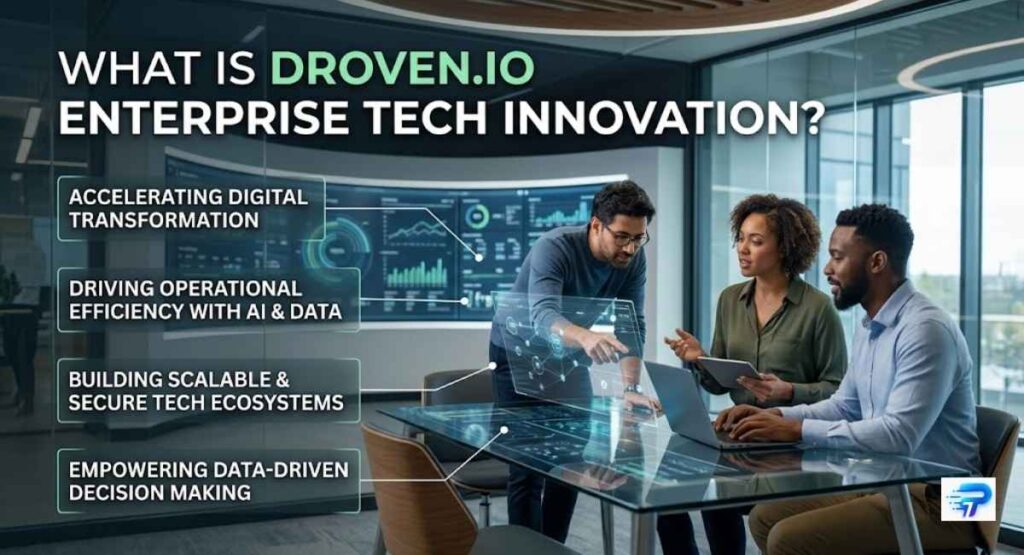
At its core, the term describes how organizations modernize their technology stack: shifting workloads to the cloud, applying AI to decision-making, automating repetitive processes, and tightening data security along the way. It’s less a fixed product category and more a way of describing ongoing change.
Most companies don’t tackle all of this at once. They usually start with whichever department is causing the most pain, whether that’s slow reporting, manual approvals, or outdated infrastructure, and expand from there.
In short, enterprise tech innovation typically includes:
- Cloud migration and hybrid infrastructure
- AI and machine learning for forecasting, support, and fraud detection
- Business process and workflow automation
- Cybersecurity and data governance upgrades
- Centralized analytics for faster decisions
Is Droven.io a Software Product or an Editorial Platform?
This is where a lot of confusion starts, and it’s worth clearing up directly: Droven.io is not enterprise software. There’s no login, no dashboard, no deployment process involved.
Based on its public site structure, Droven.io operates as a technology content platform, publishing analysis and guides across AI, IT, digital transformation, software development, and the future of work. It’s built for readers trying to understand these shifts, not for teams looking to install a tool.
That framing matters for expectations. Anyone arriving expecting a SaaS trial or a pricing page will be disappointed. Anyone arriving to understand how enterprise AI and automation actually fit together will find that’s exactly the lane it occupies.
My Personal Experience with Droven.io Enterprise Tech Innovation
Going in, I expected the usual thin content: recycled definitions padded out to hit a word count. That wasn’t quite the case. The material leans editorial, closer to how a trade publication would break down a modernization trend than how a vendor would pitch one.
What stood out was the restraint. Rather than overselling AI as a cure-all, the coverage tends to frame automation and cloud adoption as trade-offs businesses have to manage, not silver bullets. That’s a more honest starting point than most “enterprise innovation” content offers.
What Enterprise AI Tools Are Covered on Droven.io?
The coverage spans the categories most enterprise teams are actually evaluating right now, rather than narrowing in on one niche. That includes AI platforms built for workflow optimization, tools focused on intelligent automation, and software aimed at connecting existing systems through APIs and integrations.
It also touches on managed AI and ML services, the kind mid-sized companies lean on when they don’t have the in-house data science team to build models from scratch. The throughline is practical relevance: tools businesses are actually adopting, not speculative tech.
Common categories referenced include:
| Category | What It Solves |
|---|---|
| AI workflow platforms | Automating repetitive, rules-based tasks |
| Integration and middleware tools | Connecting disparate enterprise systems |
| Managed AI/ML services | Filling in-house skill gaps |
| Analytics platforms | Centralizing data for decision-making |
| Cybersecurity tools | Protecting cloud-based infrastructure |
What Are the Core Pillars of Enterprise Tech Innovation?
Strip away the marketing language, and enterprise tech innovation really rests on a handful of consistent pillars. Cloud infrastructure provides the flexibility to scale without constant hardware investment. AI and automation reduce manual work and speed up decisions that used to take days.
Cybersecurity and data governance hold the rest together, since none of the above matters if the systems aren’t trustworthy. Analytics closes the loop by turning all that activity into insight leadership can actually act on.
The five pillars typically cited are:
- Cloud infrastructure and hybrid architecture
- AI and machine learning integration
- Workflow and business process automation
- Cybersecurity and data governance
- Data analytics and centralized reporting
How Does AI Automation Transform Enterprise Workflows?
AI automation changes workflows by handling the judgment calls that used to require a human, not just the repetitive clicks. A support ticket can be categorized, routed, and partially answered before anyone on the team even opens it.
The bigger shift is speed compounding on itself. Once one workflow is automated well, teams tend to spot the next bottleneck faster, because the manual comparison point is gone. That’s why AI-driven automation tends to spread across departments once it proves itself in one.
Typical transformations include:
- Faster approvals through automated routing
- Predictive alerts instead of reactive fixes
- Reduced manual data entry across systems
- Real-time reporting instead of end-of-week summaries
What Is the Difference Between Traditional Automation and AI-Driven Automation?
Traditional automation follows fixed rules. If a specific condition is met, a specific action fires, every time, with no room for judgment outside what was explicitly programmed.
AI-driven automation adapts. It learns from patterns in data and can handle exceptions that a rules-based system would simply reject or route to a human. That flexibility is the real dividing line, not just the presence of AI as a buzzword.
| Traditional Automation | AI-Driven Automation |
|---|---|
| Follows fixed if-then rules | Learns from data patterns |
| Struggles with exceptions | Adapts to new scenarios |
| Needs manual rule updates | Improves with more data |
| Best for repetitive tasks | Best for variable, judgment-based tasks |
Is Droven.io Free to Access for Tech Education?
Yes. The content is publicly accessible without a paywall or login requirement, which fits its role as an educational resource rather than a commercial product.
That accessibility is part of why it works well for research and comparison. Business leaders and IT teams can read through the material without a sales call or a trial signup getting in the way first.
How Do Enterprise Software Solutions Integrate With AI Platforms?
Integration is where most enterprise AI projects either succeed quietly or fail loudly. Systems that don’t talk to each other create data silos, and AI models are only as useful as the data they can actually reach.
The mechanics of that integration usually come down to three layers working together: connections, triggers, and the orchestration that ties them into a coherent workflow.
API Connections
APIs are the most direct way software systems exchange data. An enterprise platform calls an API, requests specific data or triggers an action, and gets a structured response back.
This is the backbone of most AI integrations, since AI platforms need a steady, reliable feed of data to function well. Without solid API connections, even a strong AI model ends up starved of the information it needs.
Webhooks and Event Triggers
Webhooks flip the direction. Instead of a system asking for data, an event triggers an automatic push, like a new order updating inventory the moment it’s placed.
This matters for AI automation because it enables real-time reactions rather than delayed batch updates. A fraud detection model, for instance, is far more useful reacting to a transaction as it happens than reviewing it hours later.
Middleware and Orchestration Layers
Middleware sits between systems, translating data formats and managing the handoffs so different platforms can actually understand each other. Without it, connecting a dozen enterprise tools becomes a tangle of one-off fixes.
Orchestration layers go a step further, coordinating multiple automated steps into a single workflow. That’s what allows a process like “new lead comes in” to trigger scoring, routing, and a follow-up email without a human touching any of it.
What Cloud Security Standards Does Droven.io Cover?
Cloud security coverage tends to focus on the fundamentals enterprises actually get audited on: encryption, access controls, and compliance frameworks that vary by industry. It’s less about naming one certification and more about explaining why layered protection matters.
Data governance gets equal attention, since cloud security isn’t just about keeping intruders out. It’s also about controlling who inside the organization can see, edit, or export sensitive data in the first place.
Common areas covered:
- Encryption for data at rest and in transit
- Identity and access management
- Compliance frameworks relevant to specific industries
- Data governance and internal access policies
How Can Businesses Evaluate AI Automation Tools?
The starting point isn’t the tool itself, it’s the workflow it’s meant to fix. A tool evaluated in isolation, without a clear process it’s solving for, tends to get adopted and then abandoned within a year.
From there, integration compatibility and scalability matter more than flashy features. A tool that can’t connect to existing systems creates more manual work, not less, no matter how impressive its AI claims are.
A practical evaluation checklist:
- Does it solve a specific, documented workflow problem
- Can it integrate with current systems via API or webhook
- Does it scale without a full re-implementation later
- What’s the actual learning curve for the team
- Is pricing tied to usage or a flat enterprise rate
What Common Mistakes Do Enterprises Make With Tech Innovation?
The most common mistake is treating modernization as a one-time project with a finish line, rather than an ongoing process. Systems bought as a “final” solution are often outdated again within a few years.
Close behind that is skipping the people side of change. Even well-chosen tools fail when teams aren’t trained or bought in, and automation rolled out without buy-in usually gets quietly worked around.
| Mistake | Why It Backfires |
|---|---|
| Treating it as a one-time project | Technology and needs keep shifting |
| Ignoring integration compatibility | Creates new data silos |
| Skipping employee training | Tools get underused or bypassed |
| Chasing AI trends without a use case | Wastes budget on unused features |
| Underinvesting in security | Creates costly vulnerabilities later |
What Role Does Cloud Infrastructure Play in Enterprise Digital Transformation?
Cloud infrastructure is what makes most other enterprise innovation possible in the first place. Without it, scaling AI, automation, or analytics usually means buying and maintaining more physical servers, which slows everything down.
It also changes the economics of experimentation. Testing a new AI workflow on cloud infrastructure costs far less, and carries far less risk, than committing to on-premises hardware upfront.
Scalability Without the Hardware Headache
Cloud environments let businesses scale computing power up or down based on actual demand, rather than provisioning for peak load year-round. That flexibility matters most for companies with seasonal or unpredictable workloads.
It also removes a lot of the maintenance burden. IT teams spend less time managing physical servers and more time on the systems that directly affect the business.
Access to Managed AI and ML Services
Not every company has an in-house data science team, and cloud providers fill that gap through managed AI and ML services. These let businesses use pre-built models and infrastructure instead of building everything from scratch.
That access lowers the barrier to entry significantly. A mid-sized company can deploy a forecasting model in weeks rather than the months it would take to build one internally.
Centralized Data for Better Automation
Automation and AI both depend on clean, accessible data. Cloud infrastructure makes it easier to centralize data from multiple sources into one place instead of leaving it scattered across disconnected systems.
That centralization is often what determines whether automation actually works well. A workflow built on fragmented data will make fragmented decisions, no matter how good the AI behind it is.
FAQ: What People Are Actually Asking
Is Droven.io a company or a content platform?
Based on its public site structure, Droven.io functions as a technology content platform covering AI, cloud, automation, and digital transformation, not a standalone enterprise software product.
Do I need to sign up to read Droven.io content?
No. The content is publicly accessible without a login or paywall, making it usable for quick research without a sales process attached.
What’s the fastest way to start enterprise AI automation?
Start with one specific, well-documented workflow problem rather than a broad AI rollout. Solving one process well builds the case for expanding automation elsewhere.
Is AI automation only for large enterprises?
No. Managed AI and cloud-based tools have lowered the cost of entry significantly, making automation practical for mid-sized and smaller businesses too.
What’s the biggest risk in enterprise tech innovation?
Treating it as a finished project rather than an ongoing process. Technology needs shift, and tools that aren’t revisited regularly tend to fall behind quietly.
Conclusion
Droven.io Enterprise Tech Innovation, in the end, is best understood as a lens rather than a product: a way of thinking through how cloud, AI, automation, and security fit together in a modern business. The content platform itself serves that lens well, offering grounded explanations without the sales pitch.
The actual work of enterprise tech innovation still falls on the business. Choosing the right tools, integrating them properly, and training people to use them matters more than any single technology decision. Get those fundamentals right, and the rest tends to follow.

Daniel Carter is a digital content writer and researcher at PrimeTechUpdate, specializing in technology, AI, software, business, travel, and digital trends. He focuses on creating accurate, practical, and easy-to-understand content that helps readers make informed decisions. His work emphasizes clarity, reliability, and a reader-first approach.